
Málaga Spain: For the Sea, For the Spirit

Málaga, in Andalusia, Southern Spain, Has Become a City Everyone Wants to Visit
By Paul Shoul
Staff Writer
Malaga, the sparkling city on the shores of the Mediterranean, has reinvented and renovated itself in 2025. Twenty years ago, downtown was “a scary place to be avoided, especially at night,” my friend and guide Trinidad Blanco told me. Today, the streets are humming, lined by shops and restaurants serving the freshest seafood. There is a lot to see and eat here that should not be missed.
Here are my jam-packed 24 hours of eating Malaga and some key historic spots along the way, if only to burn off a few calories.

La Recova is a small cafe on a side street just off the historic center. Part restaurant and part gallery with a fantastic atmosphere, it is adorned with antiques and brilliant traditional crafts
Their menu is small, delicious, and affordable. I had their 2.50 euro breakfast. Along with coffee and bread, a series of spreads are uniquely served in an egg carton: loin zurrapa (lard and pork loin), chicharrones (lard and pork rind), Sobrasada (soft pork Mallorcan sausage made with paprika and olive oil), apple jam, carrot jam, and crushed tomatoes with olive oil.
It is hard to emphasize just how unami-savory these meat-based spreads are. Combined with one of the sweet jams, they are a flavor revelation that wakes you up as much as the strong coffee.
The best ham in the world at La Mallorquina
Traditionally, in Spain, you eat ham with your fingers, whether in a swanky Michelin restaurant or, in my case, on the side of the road by the small La Mallorguina deli that I could not pass by.
Jamon Iberico Pata Negra de Bellota is unquestionably the best ham on the planet. The acorns that free range Purebred pigs eat imparts incredible flavor and miraculous properties. Their fat is composed of oleic acid, also found in olive oil. It can help lower bad cholesterol. Ham, that is good for you. Go figure.

Try the Joselito. Considered by many to be the finest Jamon ibérico de bellota. it will blow your mind and aid in a long and happy life.

Churros in Malaga
In the city center, Churreria La Malaguena specializes in a type of Churros (fried dough) called Tejeringos, native to Cádiz, Grenada, and Málaga. They are made with thinner yeast batter that yields a smooth ring-shaped churro.. They are slightly puffy and crispy, perfect for dipping in rich hot chocolate or cafe con leche.
I’m usually not a day drinker, but……
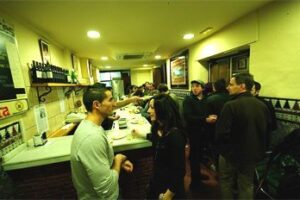
It’s 11 am. The doors of the Antigua Casa De Guardia, the oldest bar in the city, had just opened. Within a half hour, it was packed with locals. It’s a small room with long antique wooden bar sections in front of a wall of ancient oak casks filled with the region’s exceptional sweet wines, vermouth, and sherries.
The bar has a patina that can only come from age, polished and indented by countless elbows since its opening in the 1840s. The waiters are equally textured, wine-stained, and a little gruff, yet quick to return a smile as they deliver magic elixir and a few perfect tapas of fresh white prawns and plump locally farmed mussels in front of me, writing the bill on the bar with a piece of white chalk.
Wines are served in small 2 OZ (shot) glasses—just enough to try a few different varieties. As I watched the gatherings of families and friends at the bar, they sipped them slowly. Like all of Spain, the quality of food and drink is incredibly important, but it must be seasoned with conversation.

Mercado Atarazanas
I had lunch in the bustling Mercado Atarazanas. Rebuilt in the late 1800s, it has a history that goes back to the 4th century. Like most central markets, it is the heart of the city. Crowded and alive, it is divided into three sections: meat, fish, and fruits and vegetables. A smattering of small bars and restaurants offer what may be the most delicious, freshest food I had in all of Andalusia.

You must try the Conchas Finas at the Medina bar. They are large, bright orange, meaty, briny clams served raw with lemon and pepper. Grilled shrimp and monkfish with paprika and olive oil. Slightly charred iberico bellota pork, and boquerones adobados y al limón, Marinated and fried white anchovies. So good
Picasso Museum

The Museo Picasso Málaga housed in Buenavista Palace in the historic quarter, is a tribute to the artist and his love of the city where he was born. It is fascinating to see his progression as a painter through examples of his early works. He was gifted from the get-go, mastering and surpassing his father’s paintings as he developed his style.
“My mother said to me, ‘If you are a soldier, you will become a general. If you are a monk, you will become the pope.’ Instead, I was a painter, and I became Picasso.” There is even a display of the toy lead soldiers he played with as a child.
You could stare at one of the paintings for hours, trying to understand how the artist expressed himself in a way that went far beyond the boundaries of a sketch or painting. This is a unique opportunity, so leave plenty of extra time when you visit.

Málaga Cathedral
Málaga Cathedral, in the city’s historic center, is a Renaissance-style cathedral completed in the 18th century. Built on the site of a former mosque, its construction spanned over 200 years. The unfinished second tower gives it its distinctive, asymmetrical appearance, thus its nickname of “La Manquita” (the one-armed lady). Inside, you will find seventeen different ornate chapels, beautiful works of art, and the impressive choir room, lined with choir stalls (sillería del coro). It is one of the country’s most important assemblages of Baroque sculpture.

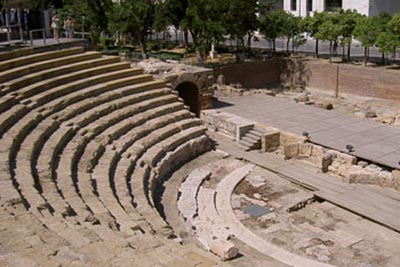
Originally constructed by Muslims during their occupation in the Middle Ages, this walled and fortified palace overlooking the harbor is in a key strategic position to defend the city. It is one of the most well-preserved in all of Spain. Just at the base of the fortress is a Roman amphitheater, built by the first Roman emperor, the oldest monument in Malaga
All good things must end.

Patio de Beatas wine bar and restaurant are housed in cojoined historic renovated homes from the 18th and 19th centuries. They are located close to the Picasso Museum.
Dinner was classic Malaga: Carpaccio de vaca, grass-fed beef lightly kissed by a blow torch; Bacalao negra en salsa de coco, Black cod (sablefish) in coconut sauce; Pressa iberica a baja temperatura, a special cut of rare Iberico pork laced with fat similar to wagyu beef; and finally, Kenel de tarta de queso, Cheesecake with chocolate sauce.
There is a Spanish saying, “Sobremesa,” meaning “upon the table” In practice, it is the leisurely time spent talking, having a coffee, or a shot of Aguardiente, after a meal, often leading to plans for the next gathering.
We talked for three hours.


Paul’s photography is rooted in first‑hand experience and human connection. He has documented everything from street food vendors in Mexico to musicians in Cuba, from small‑town festivals in New England to remote villages in the Balkans. His signature style — candid, close‑up, and emotionally honest — has made his work a defining visual element of GoNOMAD.
His images have appeared in newspapers, magazines, tourism campaigns, and exhibitions, and he is widely recognized for his ability to capture the spirit of a place through the people who live there. Paul’s travel writing combines practical insight with a photographer’s eye for detail, offering readers a vivid sense of what it feels like to stand in the scene he’s describing.
When he’s not on the road, Paul is based in Western Massachusetts, where he continues to shoot, teach, and explore the world through his lens.
- Foxwoods: Fantastic Food and Fun - March 6, 2026
- Traveling to Valencia Spain - May 22, 2025
- Moments in Mallorca - April 14, 2025



March 24, 2025 @ 11:55 am
Interesting article Paul. I couldn’t agree with you more about the way Malaga has reinvented itself. I remember 20-odd years ago walking around the old quarter at night and didn’t feel safe at all. Its certainly changed now, though. It has a great vide about it, and the tapas bars are the best. Specially Lo Gueno is located just off Calle Larios.