
Tracking the Anaconda in the Deep Peruvian Amazon

Take an Anaconda expedition deep into the remote Peruvian Amazon
By Chin Liang Teh
Senior Writer

The Peruvian Amazon is the second-largest region of the Amazon, covering almost 60% of Peru.
This primary rainforest is home to many exotic creatures, including the anaconda—the colossal, sinuous predator whose myth is often blown out of proportion by Hollywood.
It is Not What You See in Movies
“Movies often show giant anacondas gliding quickly on land. In reality, they are quite slow and sluggish on land due to their size. They are much more agile in the water.”
“Attacks on humans are very rare, and most of the time they only happen if the animal feels threatened.”
“In general, anacondas less than 8 meters in length cannot consume a human whole. Their jaws are not wide enough for an adult human. Anacondas longer than 8 meters could potentially swallow a human, but they usually avoid humans, as we are not their natural prey.”
Hector Vezirian, the founder of Amazon Explorer and a seasoned naturalist who has been exploring the Peruvian Amazon since 1999, debunked my myth about anacondas.
Dry Season is the Best
The dry season, from June to October, is the best time to spot this apex predator. Lower water levels make it easier to spot this elusive reptile as it comes out to sunbathe or moves between water bodies. Reduced water levels also make exploration and tracking easier.
Anacondas are Reclusive and Shy
“Large anacondas prefer the calm waters of remote streams, lagoons, and swamps, where food is abundant and conditions are better for survival,” Hector says. “Despite their behemoth size, they are surprisingly shy, usually submerging and disappearing when they sense our presence.”
Anacondas mostly hunt for their prey near water. They remain submerged near the shores of rivers, lakes, or palm swamps, waiting for their prey.
They are naturally reclusive, except during mating season when males compete for the attention of females.
Amazon Explorer, operating out of Iquitos in northeastern Peru, offers 8, 15, and 20 days of expeditions. Pick the one that works best for you. Each itinerary is carefully planned to explore the Amazon rainforest’s most uncharted terrain, where you have a good chance of spotting anacondas over 5 meters.
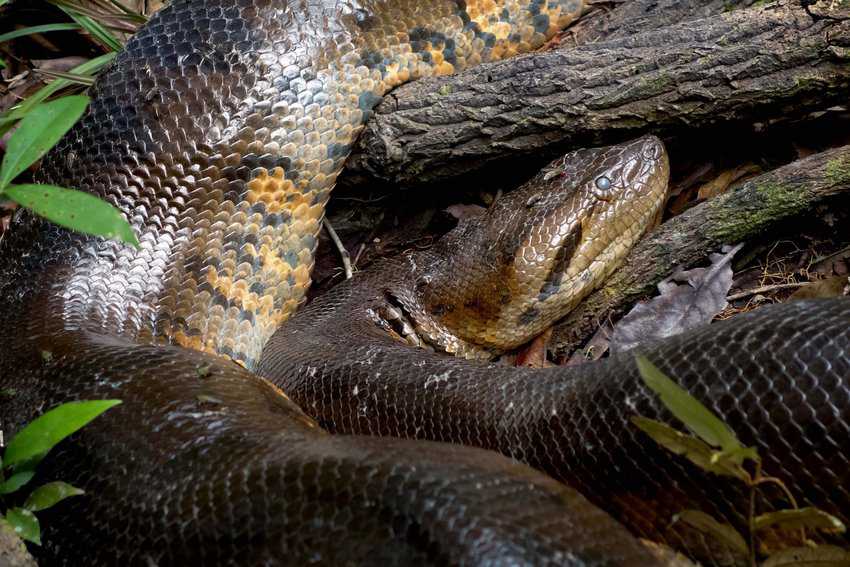
Head Deep into the Amazon
The adventure begins with a ride to the Air Force Base in Iquitos to board a small plane or float plane arranged by the Peruvian Air Force.
An hour later, the plane lands in Colonia Angamos, a border town on the Brazilian frontier. This secluded settlement runs parallel to the Yavarí River, which is the lifeblood for the community.
A motorboat will transport the guests along the Galvez River to the village of Buen Peru, the last Matses community. From there, it is another 125-mile journey along the river to reach the heart of Anaconda territory.
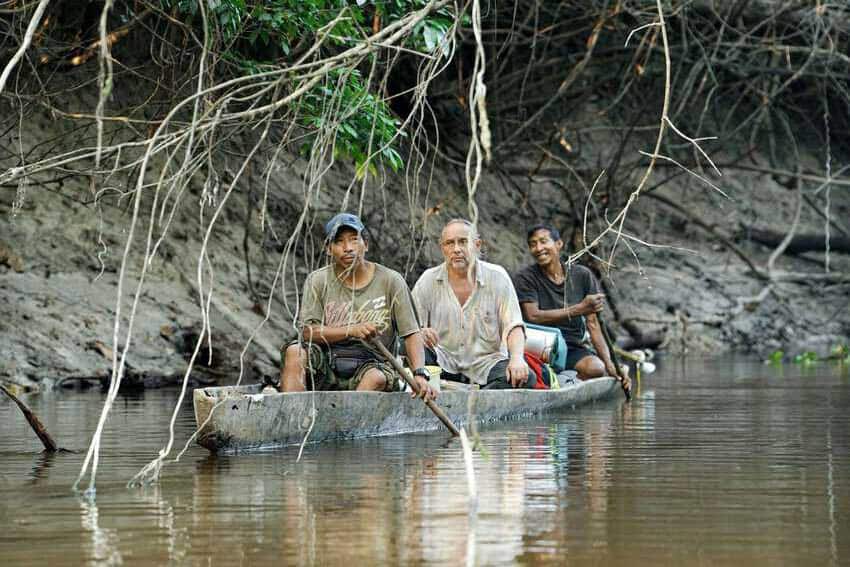
Traces of the Giant Snakes
Following closely behind the experienced indigenous trackers, participants wade through remote lakes, small creeks, and aguaje palm (Mauritia flexuosa) swamps—where giant anacondas live.
In swampy areas like Aguajales, crushed vegetation and furrows in the ground mark the passage of an anaconda. These reptiles often drag themselves through the vegetation and leave evident tracks behind.
“A swarm of butterflies on the riverbank likely means that an anaconda could be nearby. Butterflies feed on the salts and minerals found on reptile skin, such as that of anacondas, to supplement their nutrients.”
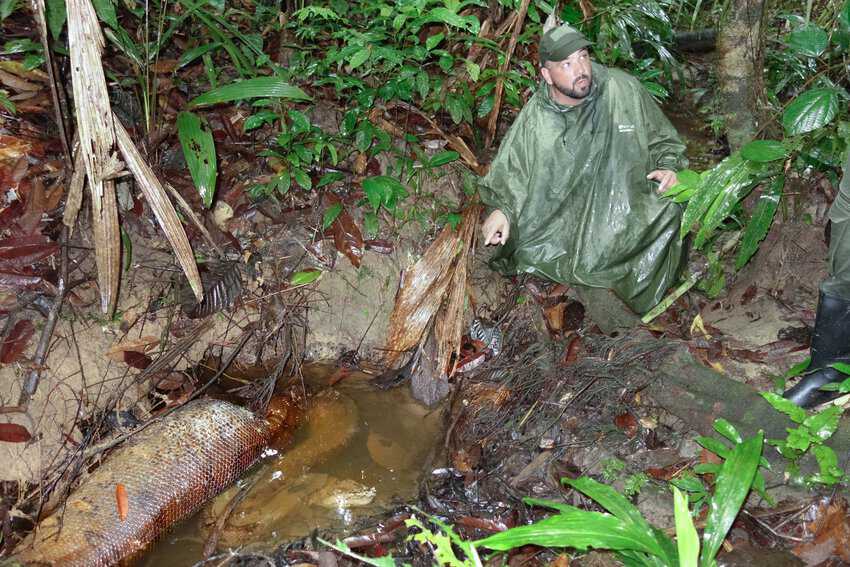
Like other snakes, the presence of pieces of leathery shed skin is a telltale sign of an anaconda’s presence.
“The level of moisture in these skins helps estimate how long it has been since they were shed, and this helps us determine the anaconda’s location,” Hector explains.
Remote dark-water lagoons are ideal habitats for finding large anacondas. The abundance of Shuyo fish (Erythrinus erythrinus) is a strong indicator of their presence.
“To maximize our chances, we do our explorations during the hottest parts of the day,” Hector says. “That’s when anacondas come out to bask and regulate their body temperature, so they are easier to spot.”
Anaconda Hunting and Wildlife Exploration
Under the boundless, towering canopy of the Amazon jungle sprawls a hidden wildlife treasure trove, teeming with a mind-boggling diversity of animals, many of which remain undiscovered.
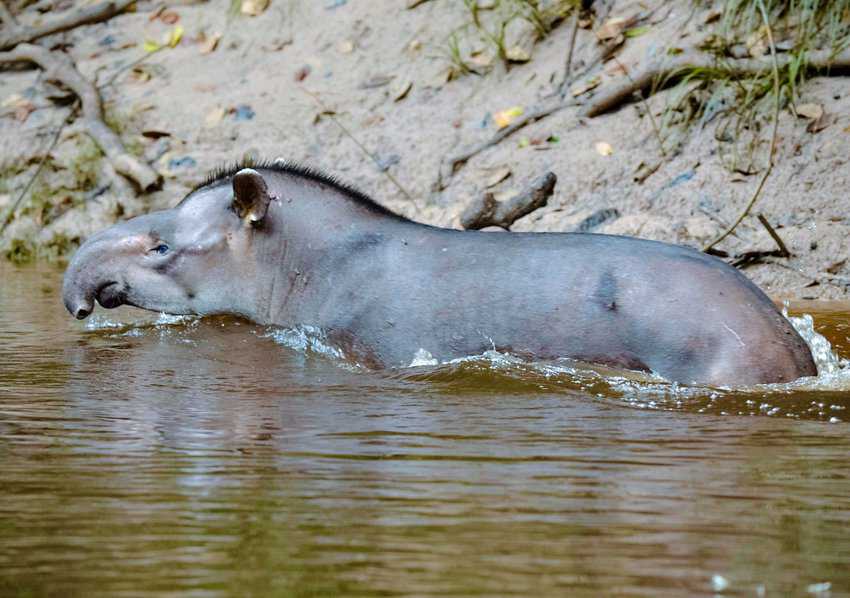
Some iconic jungle animals that can be spotted during the expedition include the Jaguar, South American Tapir, Pink River Dolphin, Giant River Otter, Humboldt’s Woolly Monkey, Scarlet Macaw, etc.
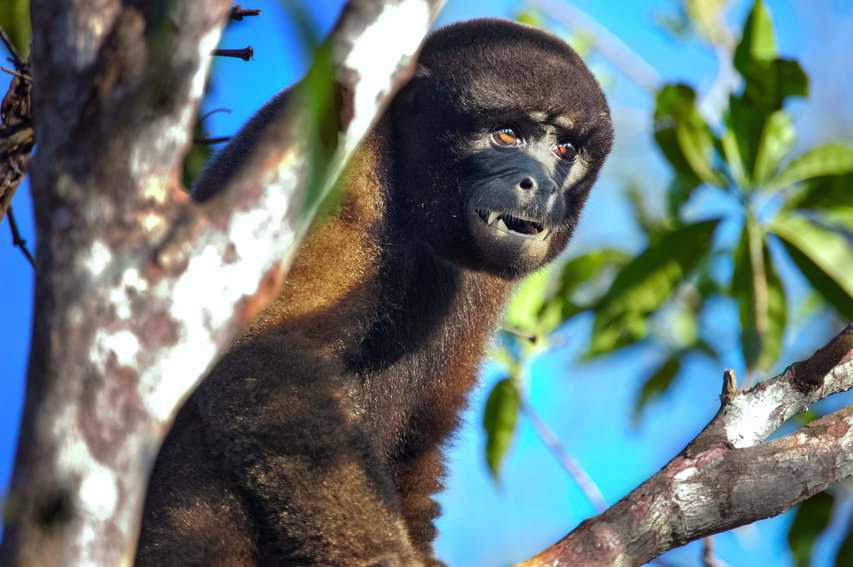
Finding these elusive jungle species takes good timing, being in the right spot, and sometimes a dash of luck. For the best chance, you will want expert trackers who were born in the jungle and are familiar with the terrain.
While searching for anacondas, participants also get to catch piranhas, search for alligators and other elusive species at night, explore clay licks or “collpas” where animals gather, sip fresh water from forest vines, and master essential survival skills—from shelter building to wild food foraging—under the guidance of Indigenous trackers.
The accommodation includes staying in a Matses village and camping in the Amazon wilderness, totally off the grid and without modern conveniences.

The Peruvian Amazon vs the Brazilian Amazon
People always see the Amazon as a monolithic jungle, but it has diverse terrains and ecosystems, such as dry elevated resting areas, floodable bajiales, and clayey and sandy soils that shape local flora and fauna.
The Peruvian and Brazilian Amazons each have distinct characteristics that influence the distribution of anaconda species.
“In Peru, the diversity of ecosystems is more pronounced, ranging from the eastern Andes to floodplains, with cloud forests, montane forests, and terra firme forests. This variety creates unique microclimates and habitats,” Hector says.
“The Brazilian Amazon is mostly diverse in its lowlands and floodplain forests like várzea and igapó. In some places, you don’t see much in the way of seasonal changes.”
The levels of endemism in Peru are also higher, with many species exclusive to this region compared to Brazil.
Both Brazil and Peru host significant populations of green anacondas. However, the density of their distribution can vary depending on specific habitats and the extent of research conducted in different regions.

Special Permits for the Trip
“We usually run 3 to 4 Anaconda tours a year. To fully maximize the experience, these trips should take more than 8 days and require a strong sense of adventure,” Hector says.
Since the trip involves entering an indigenous reserve, special permits are required: authorization to enter their territory, approval to stay within the native community, and authorization from the Peruvian environmental authority to visit the National Reserve.

“Our expedition supports local sustainability,” Hector says. “We bring in local trackers, guides, cooks, and field assistants, and we also rent boats, motors, and lodgings. This helps create jobs for the tribal community.”
“Many of them were hunters before joining us, but after 20 years, they have developed a strong environmental awareness and now work with our conservation outreach team.”
A Jungle Adventure that Pushes Your Limits
Hunting for anacondas in the Amazon is not your run-of-the-mill safari getaway. It is a true jungle adventure that will put your physical and mental strength to the test.
Participants should wear lightweight, quick-drying clothing, including long sleeves, long pants, and waterproof boots. A wide-brimmed hat, insect repellent, and sunscreen are also recommended.
Comprehensive first aid, including antivenom, should always be readily available, and it is important to familiarize yourself with emergency procedures.
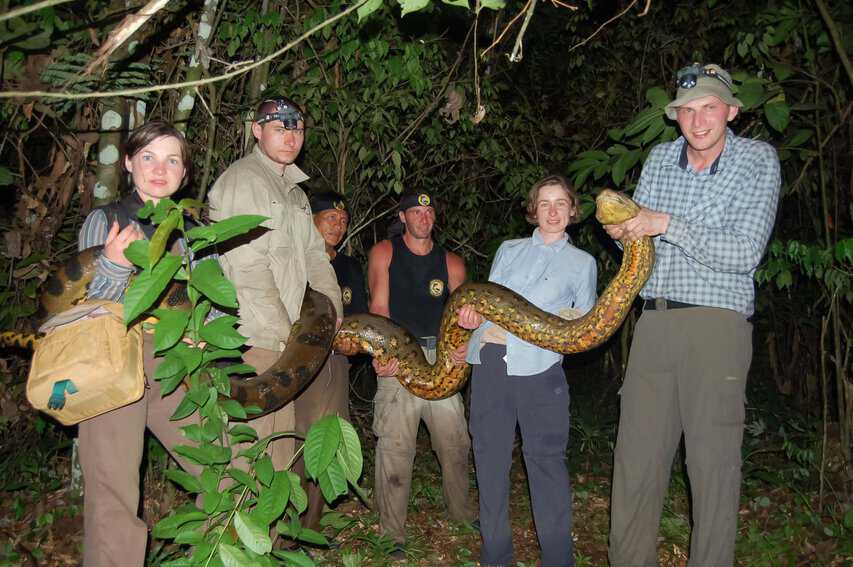
Over two decades of charting the unforgiving depths of the Peruvian Amazon, Hector has had his fair share of perilous situations. On one occasion, he narrowly escaped with his life when a massive, six-meter-long anaconda clamped its slimy jaws around his hand.
On another occasion, he traversed an impenetrable jungle alone, crisscrossed with undefined trails so treacherous that even the indigenous people steered clear. Exhausted and delirious, he barely made it out alive and came down with dengue, malaria, and intestinal parasites.
But nothing beats wrangling an enormous anaconda in a palm swamp back in 2004.
“The snake remained still in the water, with only a small part of its head visible above the surface,” Hector recounted. “I grabbed it by the neck and held on tight while my team secured its body to keep it from wrapping around me.”
“We restrained it long enough to get an accurate measurement—a staggering eight meters, way larger than what we expected. We then released it where we found it.”
Nature Always Surprises Us
Specimens exceeding 10 meters are unlikely. The green anaconda (Eunectes murinus), the largest species, can reach up to 9 meters.
“We haven’t found anything bigger yet,” Hector says. “But nature always surprises us, and the possibility of discovering a bigger specimen is what drives us to keep exploring.”


- Tracking the Anaconda in the Deep Peruvian Amazon - October 11, 2024
- Chasing Giants: Sport Fishing in Papua New Guinea - August 23, 2024
- Sanjay Colony: A Day of Unseen Life in a New Delhi Slum - August 3, 2024




May 18, 2026 @ 7:40 am
Fascinating read—this really brings the Peruvian Amazon to life beyond the usual myths. I liked how it separates Hollywood imagination from real anaconda behavior and focuses on the ecosystem and local expertise. Makes the expedition feel more respectful and grounded than sensational.
April 30, 2026 @ 5:30 am
A fascinating insight into how diverse the Amazon really is. It is easy to think of the Amazon as one endless rainforest, but this highlights how varied its ecosystems truly are. The contrast between the Peruvian and Brazilian Amazon also explains well why species distribution, including anacondas, can differ so much across the region.
April 28, 2026 @ 7:06 am
Fascinating deep dive into the Peruvian Amazon—equal parts thrilling and educational. The real-world insights about anacondas beyond the myths make it a gripping read!
November 15, 2024 @ 1:13 pm
As you mention in the article and in the movie Anoconda, I find a difference. As you say that Human is not natural prey, I feel it. Nice photo and article about animal of amazon. Thanks for sharing!!
October 17, 2024 @ 1:58 am
Nice wildlife photography. I Wonder how to hunt Anaconda, the large reptiles on earth. It was interesting to read your article.