Northern Sweden: Family, Ferries, Forsen
Northern Sweden: the Arctic Circle and Platters of Gravlax
By Karel R. Amaranth
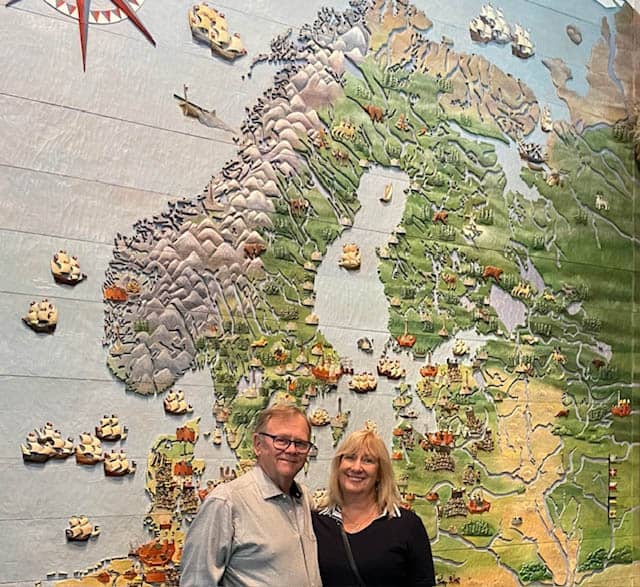
My Swedish descent husband, Kurt and I started our early Autumn Scandinavian adventure with a few days in lovely Oslo and then the amazing train trip across Norway from Oslo to Bergen, one of the most magnificent train rides in the world from the fjords up through the rock and ice mountains and down to the coast.
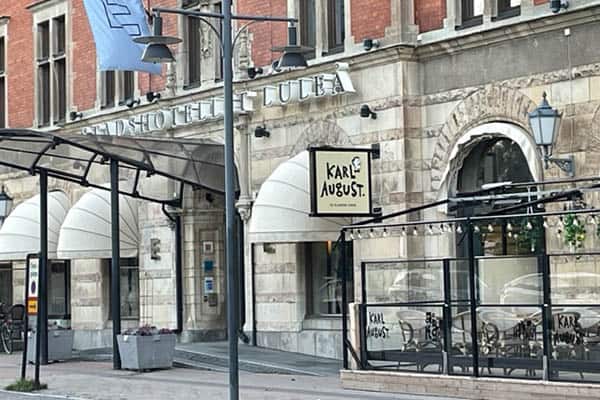
After a day in the Bryggen, the historic section of Bergen along the harbor, and a mountain hike at the top of Floyen, we had an evening flight from Bergen Airport that landed us in Lulea, Sweden at about 11:00 PM. Pretty tired from our long day and traveling we were happy to arrive and be greeted by the front desk host at the Stadshotellet Lulea. Magnificent!
Built in 1907, it is beautifully restored, with marble grand staircases and attractive décor. We settled in to our deluxe room, ($130/night including breakfast,) for our four night stay.
The next morning, we were treated to a smorgasbord breakfast in the Neo-Classical ballroom with its 30 foot embellished ceilings, dazzling chandeliers and views of the sparkling Bay of Bothnia.
Lulea is a small city (population 46,600) and is both the historical old city, Gammelstad, and the current commercial gateway into Norrbotten, Lapland and to the Arctic Circle about 150 K or 93 miles north.
It is located on the shore of the Bay of Bothnia, which is strewn with the archipelago’s 4,000 islands; this surrounding bay, noted by Facebook in their decision to locate their data storage there, gives Lulea it’s “beneficial climate.”
While the hotel retains the charm of Lulea’s past, the downtown area is a row of stores, including the ubiquitous Swedish and worldwide H&M. The first morning we found a walking path along the shoreline and stopped in at the Norrbottens Museum (free) which houses cultural artifacts from the region.
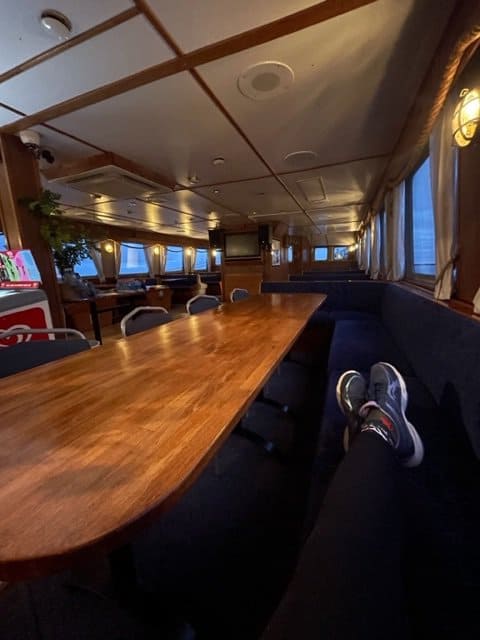
Later in the day we settled into the big velvet seats on the Synfoni Boat which leaves out of South Harbor for a six hour tour of the upper Bay and the pine and birch covered islands. I recommend this boat trip if you are a little travel weary, but aren’t quite ready to just hunker down in your hotel room.
For about $35 for the boat ticket you can relax, bring a book, play cards, eat the surprisingly good food, enjoy local beers, and watch the islands drift past. The boat is used by people traveling to stay in the little red cabins that adorn the green islands like Christmas tree ornaments. We met people on their way to a weekend of fishing, hiking, kayaking and just relaxing.
The following day was our Swedish Heritage Day, an opportunity to explore the area where Kurt’s grandmother, known as Nonnie, had been born in 1900 and lived with her eight siblings and parents until the age of 20. Kurt had two photographs of the house, a black and white almost a hundred years old that Nonnie had given to him, the other in color about 30 years old from a cousin who had visited.
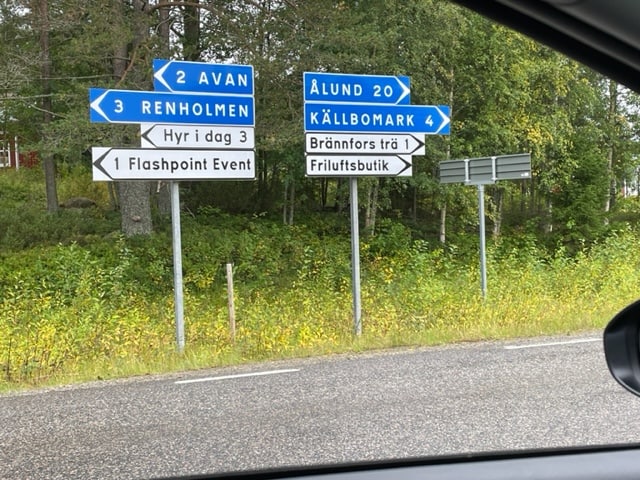
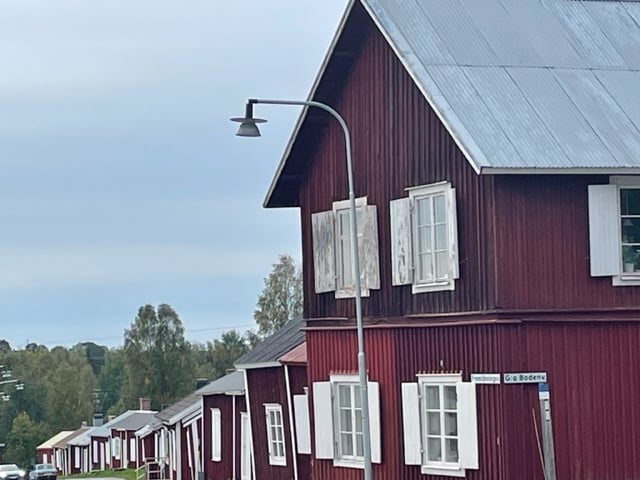
The house was described by the cousin as “a red house on the left side of the street” in the village of Renholmen about 50 miles south of Lulea. Renholmen is literally a one road town of one red house after another tucked into the forest along a stream leading to an inlet.
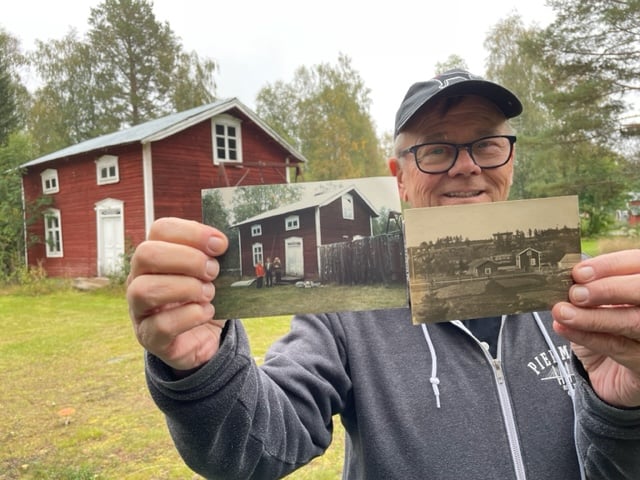
We drove to the end of the road and turned around thinking the house might be gone or renovated beyond recognition, but as we drove back, I noticed the windows on one house that matched both photographs and we had found Nonnie’s house.
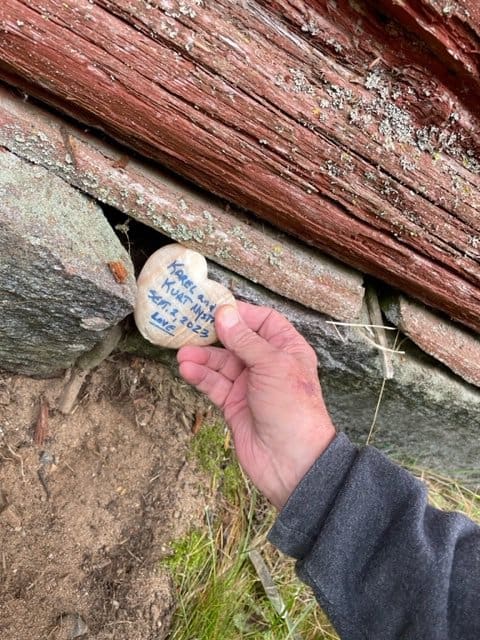
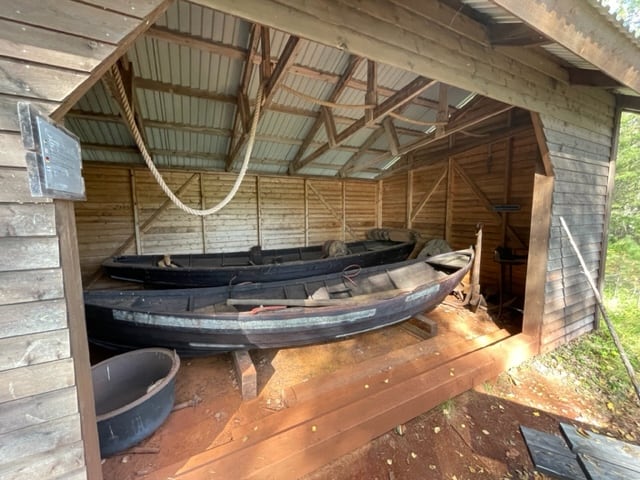
It is now a storage building for fishing nets and no one was there so we were able to walk around and know that this was the place where Emmy lived, tragically lost her mother at an early age, grew up and married Paul from the neighboring village of Abyn, then traveled to New York and settled in Iowa.
For anyone considering a heritage trip, whether in your home town or around the world, do it, it is a wonderful experience.
The next day we decided to explore the area north of Lulea. We traveled this time north to Happaranda where I reluctantly gave up the opportunity to go to the IKEA store.
We continued north with the intent of not only crossing, but memorializing with many Christmas card worthy pictures and maybe even souvenirs, THE ARCTIC CIRCLE.
It was a lovely drive along the Torne River with frequent views of villages and cottages on the opposite shore in Finland.
One man we spoke with on the Synfoni who was on his way to the island of Hinderson, had told us that there was a very good fish restaurant in Kokkolaforsen, right near the waterfall (forsen) and the fish served were caught right there in the river.
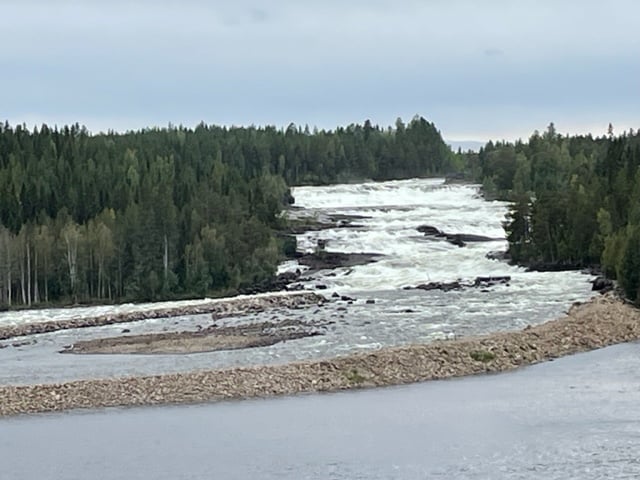
We saw the big KOKKOLAFORSEN sign on the road side and pulled in. He was certainly right. The river was crashing over rocks in powerful rapids and there were men with big nets catching fish, which we later enjoyed for lunch in the charming restaurant.
We were on our quest for the Arctic Circle so we drove on. From Kokkola we drove through flat pine forest watching the blue dot on my cellphone Google Map edge closer and closer to the line on the Earth where at 65.58 Latitude the sun never sets completely on the Summer Solstice and never rises on the Winter Solstice.
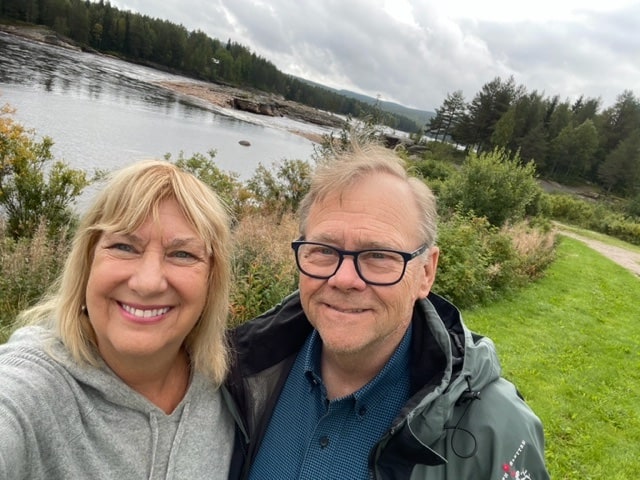
We were surrounded by trees, and on an ordinary well-paved Swedish road, no signs, moose or arctic edifice as the blue dot on my cellphone map glided over that literal imaginary line. We stopped a few miles beyond at a rest area where there were maps and the same cascading river we had seen at the restaurant.
So, there we were above the Arctic Circle, feeling pretty disappointed that this was not the photo op we had hoped for, but when I think about it now, and look at pictures of the Arctic I think, yeah, we were there in Norrbotten Sweden, Lapland above THE ARCTIC CIRCLE. This area of Sweden and Finland is the only place on Earth above the Arctic Circle that is a “subarctic climate” on the Koppen Climate Scale.
Take a look at a north pole projection map and you can see the slice of green in the otherwise gray rock, ice and tundra that sit within that circle. That’s pretty amazing. Sometimes travel is like that: you don’t totally grasp the wonder until you have returned. We did return to the Kokkolaforsen restaurant for fish that had just been swimming in the river, and as usual excellent beer.
On our final Lulea day we drove over to Gammelstadt, the Kyrkestadt “Church Town” founded in 1621. It is a UNESCO World Heritage Site that truly lives up to that designation. At its center is the 15th-century Nederlulea Church, a large cathedral with vaulted ceilings.
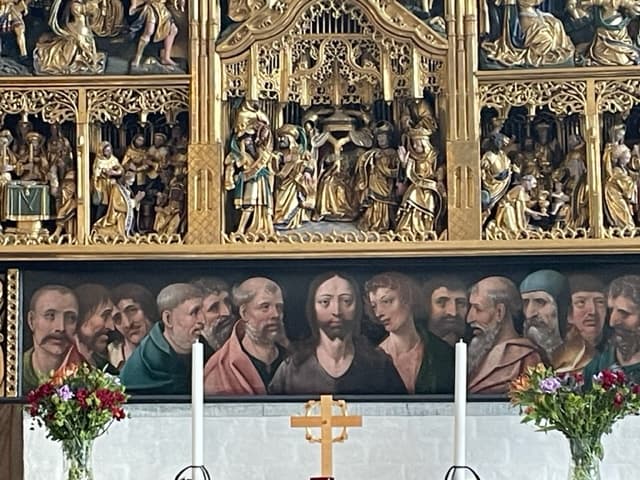
Once simply decorated with a brick floor and stone walls, the Church was later embellished with a gilded altar piece from Antwerp, paintings by several famous artists and the magnificent pulpit, exquisitely carved, painted, gilded, and installed as the “sermon place.”
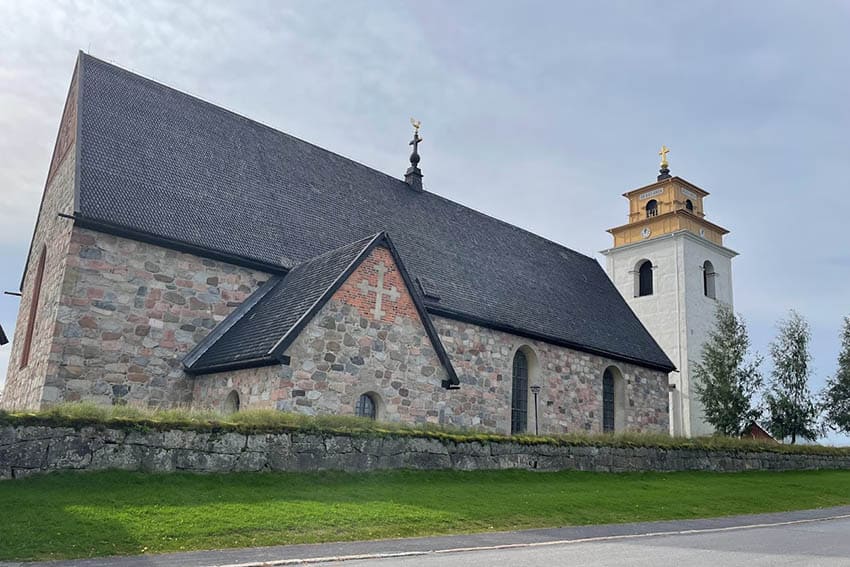
The Church is surrounded by the town of 424 red wooden houses that were built for parishioners who had to travel long distances from the countryside to worship on Sundays and during religious festivals.
This community became the place where families and friends gathered from distant homes, holidays, marriages and passings were celebrated. Young couples met and romanced in overnight above the covers snuggling as “rehearsals for marriage,” a Kyrkestadt custom.
Our last northern Sweden adventure was to Storforsen in Vidsel. From Lulea, we drove west into the pine and birch forests, where there were occasional farms, markers with names of villages, (but no actual villages, just a house or two,) and Moose Crossing signs although we, as usual, did not see any moose.
After an hour’s drive we reached the Hotellet Storforsen, a main building and several cottages built right on the banks of the Pite River at the bottom of the falls that drop 300 feet from the upper rapids. We had a deluxe room facing the falls ($250/night) with a small balcony.
The lobby, bar and restaurant sport a collection of large stuffed creatures: bears, badgers, a fox, a wolf, many of them somewhat motheaten (we photographed them wearing Barbie sunglasses.) Shortly after arriving we went for a hike along the river and up to the falls, which are a series of rapids that crash, splash and wildly tumble for about 3 miles before reaching Storforsen’s final cascade.
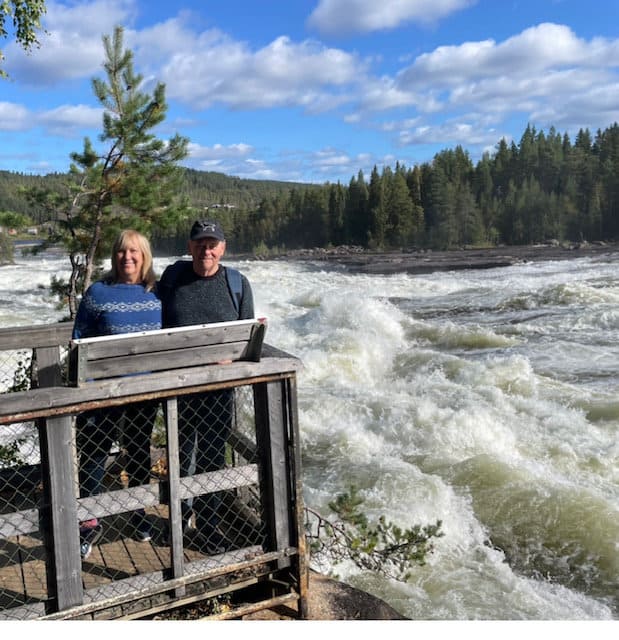
The hotel is surrounded by the Storforsen Preserve which has several trails including the 4.5 mile loop along the river and through the forest with a raised platform walkway back to the hotel. Trails are well-marked and maintained, most of them graveled.
The Pite River was a major water route for logging, bringing the logs from the mountains and forests to the Bay of Bothnia at the small city of Pitea. There are trails that bring you right along the banks and onto stone embankments that were built to keep the logs on as straight and narrow a passageway as possible in the wild rapids.
The following day we explored more of the Nature Preserve Trails including one that took us to a fishing shack and up onto a ridge with wonderful views, then back down to the crashing rapids.
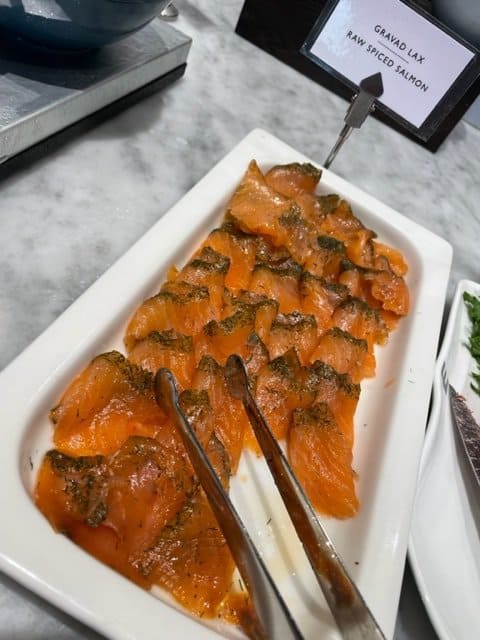
We enjoyed an excellent buffet dinner and after a good night’s sleep with only the sound of the cascading water we indulged in another sumptuous breakfast, including the ever-present platters of gravlax, made sandwiches with Swedish bread, cheeses, salami and ham, and set off for Lulea airport and our flight to Stockholm, which is its own jewel box of islands, museums, and parks.
NOTES
The train from Oslo to Bergen can be booked directly at www.vy.no I recommend taking the train as far as Myrdal which is at the top of the mountain range, taking the cog railway down to Flam, and then the boat from Flam to Bergen which you can book at www.norled.no
You can also stop for a night or two along the fjord in Balestrand and stay at the Midtnes Hotel ($130/night including breakfast) to explore the village and go canoeing on the fjord.
I had fun learning some Swedish prior to the trip with a Babbel subscription, but I didn’t have much opportunity to practice since all the very friendly Norwegians and Swedes we met spoke English!
Ferries in locations on any body of water are good opportunities to relax, enjoy the views, and meet local people. They are typically inexpensive since they provide commuting transportation. In addition to the ferry in Lulea, we took ferries in both Oslo and Stockholm
No cash! Most hotels, stores and restaurants only take credit cards and literally have no cash.
For reference, in all of Canada there is one road, the Dempster Highway, with many sections unpaved, that goes north over the Arctic Circle. Sweden has four nicely paved and well-maintained roads going over the Arctic Circle.
Karel R. Amaranth, MPH, MA, has traveled extensively to work on public health projects supporting maternal and child health, including trips to Nepal, India, Uganda, Burundi, Brazil, and Colombia. The gypsy in Karel’s soul has led her to many destinations in the United States, Iceland, Venezuela, Ecuador, Wales, Norway, Sweden, Finland, Costa Rica, Ireland, Hong Kong, and the Faroe Islands, documented in an article published by Go Nomad, The Faroe Islands, Like the Mystery of Falling in Love. The homebody in Karel’s soul and her love of her family also keep her anchored in the little Hudson River village of Piermont, New York.


- Living Free as a Digital Nomad in Thailand - May 21, 2026
- The Quiet Travel Moments We Remember Most - May 21, 2026
- Portland Maine for Tasty Lobster and City Flair - May 20, 2026