
Living the Gold Rush in Coloma, California

The Coloma Gold Rush: An Historic Recreation
By Inna Tysoe
Coloma Gold Rush Live describes itself as a walk back in time. An immersion in the year 1850 might be more accurate. Every year on the second week of October, volunteer re-enactors and historians gather in a couple of Coloma meadows and live the way they did in 1850 for three days. We, modern-day people, are welcome to visit and watch them go about their lives.
The Mormons
The Mormon cabin is one of the first things you see as you step onto the sun-drenched meadow. Here, my husband and I cut off a bit of wood using a two-man saw just as people did back then.
Alternating between pulling and sawing through the wood was hard work but the result was worth it. Then we stepped into the coolness of the cabin where the lady told the story of the Mormons.
When Marshall discovered gold, there were so few people in California that many of Sutter’s workers were Native Americans and maybe half were Mormons from the Mormon Battalion (formed to fight in the Mexican American War).
Mormons Signed on to Work
The Mormons had signed on to work at the mill for a few months to support the fledgling colony of their co-religionists in what is now Salt Lake City.
When James Marshall discovered gold, they agreed to stay on for the remainder of their contract if they could pan for gold in their spare time. But once their contract was over, they sold their panning tools and left to join their families in Utah, building the Mormon Road while they were at it.
In the twentieth century, the Mormon Road became the Arrowhead Trail, one of the first auto highways between Utah, Nevada, and Southern California. Today, if you go down the I-15, you are driving down a route that runs parallel to the Mormon Road.
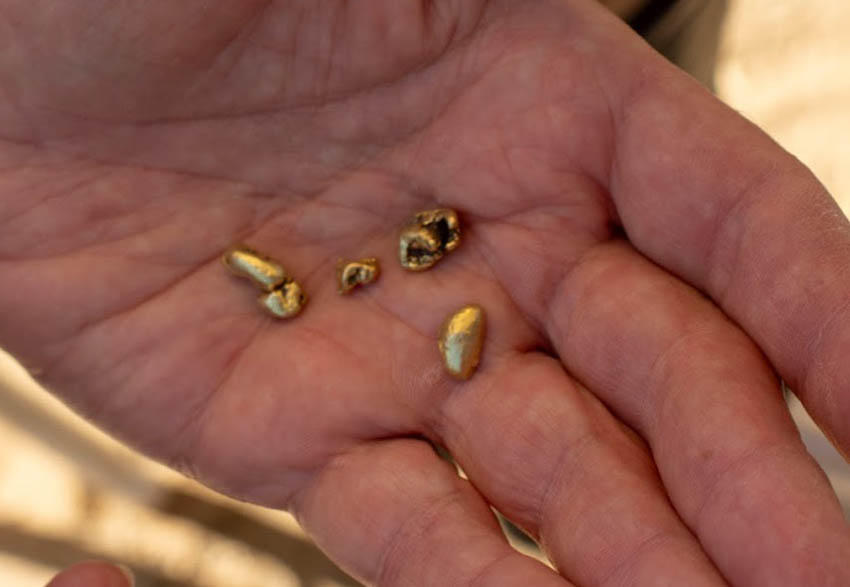
Once the Mormons rejoined their families in Utah, they used the gold they found (and since they were the first on the scene, they found quite a lot) to build Salt Lake City. California’s gold thus built two states.
The Masons

Masons, too, flocked to California. My husband and I visited a replica of one of the Masonic tents. The men manning that exhibit told us that so many Masons flocked to Coloma that in 1850, over 30 such meeting tents had sprung up virtually overnight, much to the consternation of other miners.
We looked around and I could not work out what all the fuss was about. It was a regular meeting tent, 1800s style.
Inside the tent, I spied a bible, voting stones (white for yes and black for no), a few chairs, and a typical 1850s picture on the “wall” of the tent of some presumably important personage looking properly heroic with his hand in his cloak.
The Masons were not the only ones to trek to California. When James Marshall started the sawmill, there were fewer than 10,000 people in the land that would later become the Golden State.
But once people found out about the gold, over a quarter of a million people from all over the world came here in a mere three years.
No wonder then that even in 1850 (the year Gold Rush Live re-enacts) most people lived in tents. Even the boarding house and the blacksmith workshop were tents.
The Boardinghouse
The boardinghouse seemed (at first glance) to be an extraordinarily large and rather luxurious-looking tent structure.
The lady “who ran it” explained that she let out only half the tent. The nice-looking beds were for her, her sister, and her son. Her son slept in the slightly smaller bed and she and her sister shared the bigger bed.
The dingy-looking mattresses on, if anything, even flimsier cots she let out. Two miners would share a cot if the demand was low. If lots of people needed a place to stay, she would put three miners in the same cot. If Coloma was bursting at the seams, she would fill up the floor as well. The rates she charged were outrageous for the time ($5 per week, payment up front)—made more so since everything had to be paid for in gold. California did not have its own currency. And the small fortune the miners shelled out did not even include bedding.
They had to bring their own blankets, covers and anything else they needed. (Though where they would store their provisions, I’ve no idea.) I asked why she charged so much, and all up front and the proprietress explained that miners were liable to hear of gold in Auburn or some such and would leave without a word to anyone, chasing the mirage of instant wealth.
She would never hear from them again. If a miner didn’t show up for a night, she’d sell his spot from underneath him. As to why she charged $5—she thought that was fair. A miner made about $7 per week on average, after all. And sure, there were good weeks and bad but really was that her problem?
The Variety Store
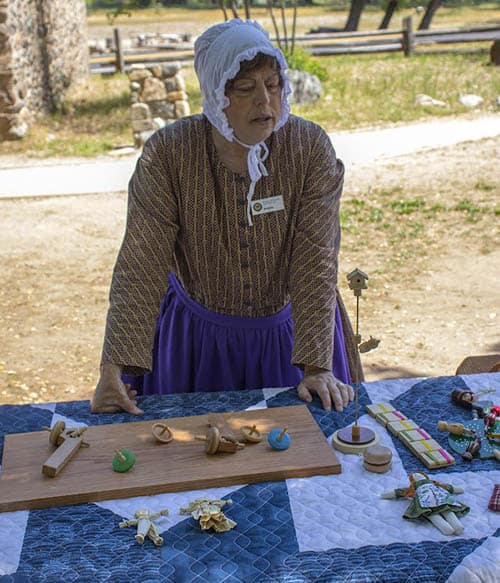
The lady who ran the variety store very much shared that attitude. She sold a little of everything: from dried food to arsenic pills. In 1850, a woman was considered her husband’s property. As such, she didn’t have an income of her own. Even if she ran the store and he didn’t do a thing to help.
Her husband could choose to give her some of the money she earned, but it was (legally speaking) his money. On the other hand, it was easy for a woman to divorce a man who mistreated her for the simple reason that there were so few women around. As a result, ladies of good renown and otherwise were in high demand.
If a woman showed up at the justice of the peace saying she wanted to divorce her husband, her appeal would be granted as quickly as it took him to write out the necessary document. So if I wanted a divorce—no problem Though she advised me to concoct a story to preserve my reputation.
I thanked her for the advice but asked her why she sold such curious wares. Wasn’t arsenic poisonous? Yes, of course it was. Which is why she doesn’t use it herself but if a woman wants to look like a lady out here in the land of the scorching sun, what choice does she have?
A lady must have pale skin—and how can she achieve that naturally with the sun beating down on us as it is? So, she must resort to arsenic. It will make her skin white enough. It will make her feel poorly but she will be a lady. But don’t use more than one pill per day. That way lies death. Also, don’t use nightshade to make your eyes big and seductive. Nightshade too is a poison and putting that in your eyes, she shook her head. Women will go blind or crazy or even worse.

The Blacksmith
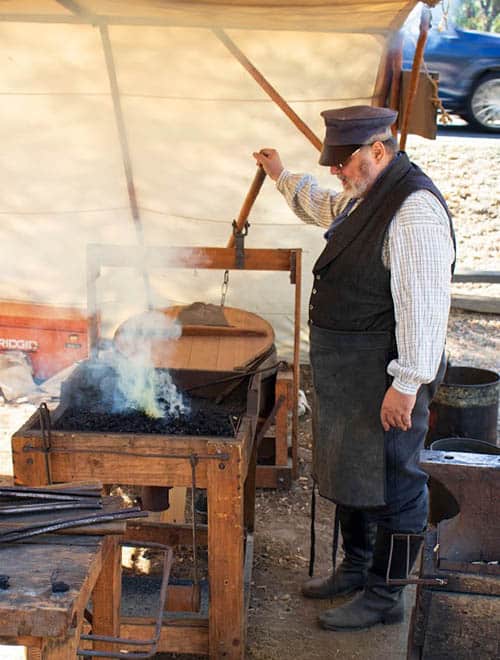
And we were off to see the blacksmith. He was cheerful and competent as he toiled in his tent with the sun beating down on him and the fire going.
In 1850, he told us, most blacksmiths worked in tents just like that one. Just then he was building up a fire in his forge to fashion a fire striker.
I watched a little boy stare open-mouthed at him as he worked. A future re-enactor perhaps? The boy was certainly fitter than I. Between the sun and the forge, I was getting quite dehydrated.
Taking a Break (in the Modern World)
My husband took pity on me and took me to the nearby Argonaut café where we feasted on grilled cheese bagels and great ice cream. Argonaut was perhaps the only place in Coloma that wasn’t authentic 1850 that day.
The Museum
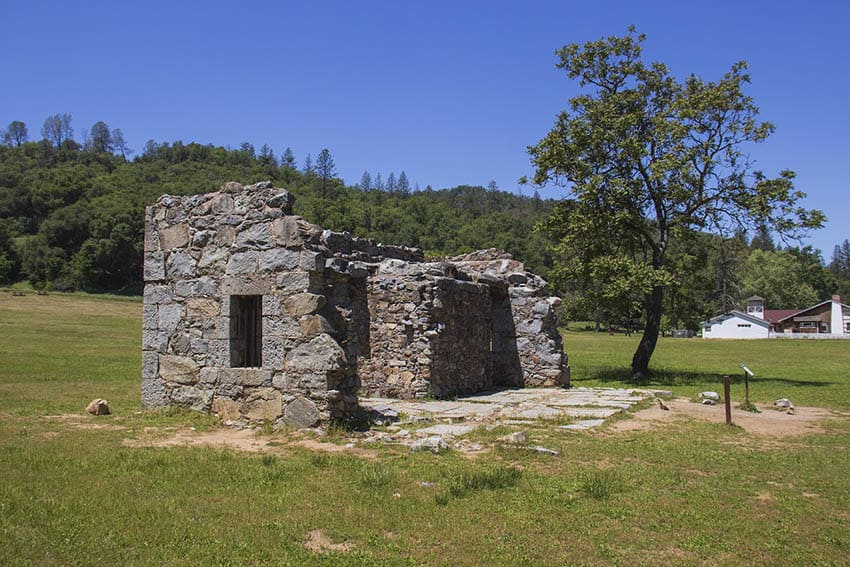
If the local museum exhibits are anything to go by, the tent city was most certainly authentic. By 1850, the lady at the boardinghouse told us, there were some log cabins. In fact, our tour of that year started with the one Mormons had built.
In addition, there was a general store and (of course) a jail. So it was not all tents. But most of it was for no-one planned to stay in California very long.
The idea was to come here, get rich quick and leave. As a plaintive letter on display at the museum put it, “It’s not home.”
Air Conditioning 1850 Style
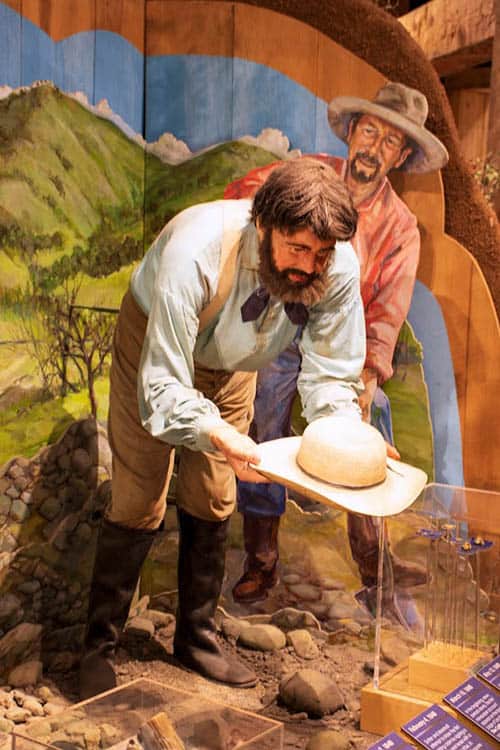
But even in 1850, there were elements of a home. The general store, for example, displayed a huge sign that said, simply “Coffee.” As I was getting quite the headache from the sun, I was most eager to sample the coffee made a la 1850.
Sadly, the sign was false advertising. But the minute I stepped into the store I was cool. It was like someone had turned the AC to 70 or maybe even lower. What was going on?
The men minding the shop explained that it was the wind. Not only were the front and the back door of the cabin open but there were gaps under the eaves. The effect was a kind of wind tunnel that made the cabin feel like a cool haven.
So even though they didn’t serve coffee, I really didn’t want to leave. But there was so much to see and so many stories to hear that leave we did.
Spills and Chickens
Straightaway we ran into a lady who was having trouble with her chickens. A friend helped her out. After that minor drama, watching a man make a spill felt oddly calming.
I looked on as he tightly rolled a thin strip of wood which he would later dip into beeswax. The result was a spill—which he could use to transfer fire from hearth to candles. Something that every household needed in California in 1850.
By showing us how to make it, the man was trying to preserve a skill that has all but disappeared. But then, that’s what Coloma’s annual Gold Rush Live is about: preserving our history.
And like all human stories, that history is good, bad, ugly, and often sad. But it is also fascinating and worth preserving.
So, if you find yourself in Coloma the second week of October, I would recommend dropping in on 1850 during Gold Rush Live. You won’t regret it.

Inna Tysoe loves writing about local attractions and people.


- Birmingham: Visiting England’s Least Cherished City - May 26, 2026
- Cruising the Red Sea - May 25, 2026
- Living Free as a Digital Nomad in Thailand - May 21, 2026

March 19, 2024 @ 6:54 am
San Francisco, California: Discover the charm of the City by the Bay with its iconic landmarks, eclectic neighborhoods, and culinary delights. Take a stroll across the Golden Gate Bridge, explore the vibrant street art of Mission District, or indulge in fresh seafood at Fisherman’s Wharf.