
Sketching Through Jet Lag: Travel Watercolor Kits
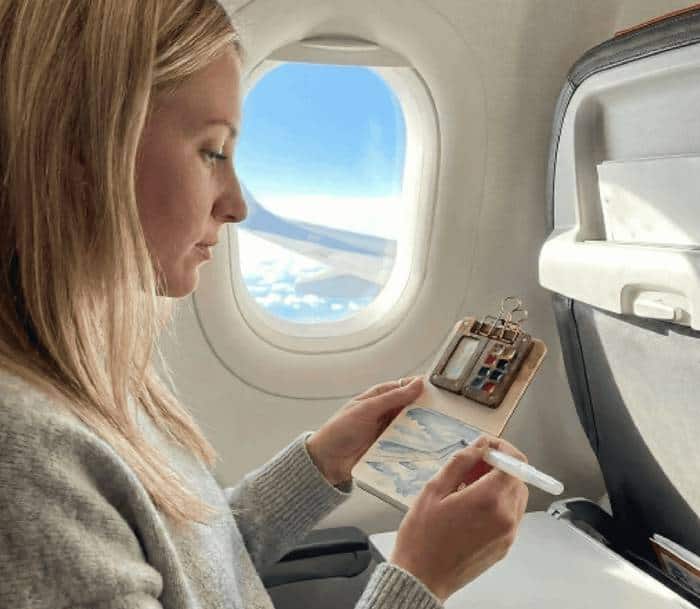
Sketching your way through Jet lag: Why travel artists keep a watercolor kit in their carry-on
By Oscar Davis
The best souvenir I ever brought home from a trip was a messy, slightly warped half-page painting of a bowl of congee at Bangkok‘s Don Mueang Airport.
It was 4:17 a.m. local time. My connecting flight was five hours away. I was too wired to sleep and too tired to read. So I painted breakfast.
Jet lag is a sensory problem, not just a sleep problem
Most advice about jet lag focuses on melatonin, hydration, and adjusting your watch. That’s fine. But the part nobody talks about is the weird, floaty disconnection you feel in transit. Your body is in one time zone, your brain is in another, and everything around you looks both real and slightly unreal.
Painting forces your eyes to actually look. When you sit in a departure lounge and try to mix the exact grey of the floor tiles with a water brush, your brain re-anchors. You notice details: the yellow cast of the overhead lights, the turquoise of a gate agent’s scarf. You come back to wherever your body actually is. Bringing along a travel watercolor kit is a great idea.
Cameras are great, paintings are different
I carry a phone with a perfectly good camera. I take hundreds of photos on every trip. And I look at maybe six of them afterward.
A watercolor sketch works differently because it takes time. You spend eight or twelve minutes staring at one view, deciding what to leave out, which color to put down first.
That slow attention burns the scene into your memory in a way a shutter click cannot. Neuroscientist Daniel Schacter at Harvard has written extensively about how active encoding (doing something with information rather than passively recording it) strengthens memory formation. Painting is about as active as encoding gets.
You do not need to be talented
I need to say this clearly because it stops people before they start. Travel watercolor painting is not about producing gallery-worthy art. It is about the act of looking and responding. My congee painting looks like a beige puddle with a spoon in it. I love it anyway because it puts me right back in that plastic airport chair, half-delirious, tasting chili oil. If you haven’t touched paint since primary school, that is completely normal. Most adults who start painting on trips are genuine beginners. The low stakes are the whole point. Nobody is grading you at Gate B14.
The gear question used to be a real obstacle
 Travel watercolor painting has been around for centuries. J.M.W. Turner hauled a painting box across the Alps in the 1800s. But Turner had porters. For the rest of us, dragging tubes of paint, loose brushes, a palette, a jar of water, and a pad of paper through airport security sounds exhausting.
The barrier to entry has dropped dramatically in recent years. All-in-one pocket watercolor sets now exist that weigh almost nothing. The best ones clip a small paper pad, a dozen pigments, and a water brush into a single unit you can toss in a jacket pocket. If you want a solid beginner-friendly option designed specifically for painting on the go, you can shop at tobioskits for a kit that includes everything from pigments to cotton paper in one compact package. Zero setup, no water cup to spill on your seatmate.
Layovers become something you look forward to
A three-hour layover in Frankfurt used to feel like dead time. Now it is a window. I have a small collection of airport paintings: the curved ceiling at Istanbul’s new terminal, a half-eaten croissant at CDG, rain on the windows at Heathrow.
None of these are beautiful places. That is sort of the point. Painting makes you pay attention to spaces you would otherwise just endure. The mundane becomes interesting once you try to get its colors right.
Transit painting as a grounding practice
There is a growing body of work on art-making as a mindfulness practice. A 2016 study published in the journal Art Therapy by Girija Kaimal and colleagues at Drexel University found that 45 minutes of art-making significantly reduced cortisol levels in participants regardless of their artistic experience. You don’t need to paint for 45 minutes at an airport gate. Even ten minutes shifts your mental state.
Travel is stimulating but also genuinely stressful. Crowds, delays, unfamiliar languages, bad sleep. Sitting still and mixing colors is a small pocket of calm you can create anywhere. I find it more restorative than scrolling my phone for the hundredth time.
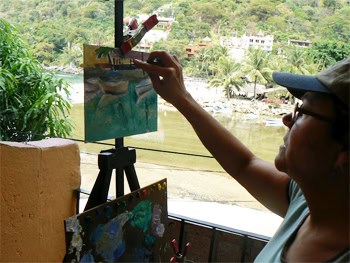 What to actually paint when you’re in transit
People freeze up because they think they need a scenic view. You don’t. Here is what works when you’re stuck between flights or sitting on a train. Paint your food. A cup of coffee, a sandwich wrapper, an orange peel. Food is small, still, and forgiving. Getting the color slightly wrong doesn’t matter because nobody knows what shade your latte actually was.
Paint the view from your seat. A window with tarmac and a wing. A platform with overhead wires. These are honest travel images, more truthful than any postcard.
Paint from a photo on your phone. If you saw something amazing three hours ago and you’re now stuck indoors, pull up the photo and paint from it while the memory is fresh. The painting will have more life than the photo because you’ll add what you remember feeling.
The social side nobody warns you about
Painting in public is a conversation starter. I have been approached by curious strangers in airports on four continents. People lean over, ask what I’m painting, and tell me about their grandmother who used to paint. A retired teacher in Lisbon once sat next to me and watched for twenty minutes without saying a word, then thanked me when her flight was called. If you’re a solo traveler, this matters. Painting opens a door that headphones and screens close.
Keeping your kit carry-on friendly
A few practical notes. Water brushes (the kind with a reservoir in the handle) eliminate the need for a water cup entirely. You squeeze, you paint, you wipe the brush on a napkin. TSA has never blinked at mine. The pigments in a solid pan set are dry until activated, so there is no liquid to worry about. Cotton paper holds up better than regular sketchbook paper because it doesn’t buckle as much when wet.The entire setup should fit in less space than a paperback novel. If it doesn’t, it’s too complicated for travel.
Start before you think you’re ready
The biggest lie people tell themselves is “I’ll start painting when I get better at drawing.” That’s backwards. Watercolor is forgiving precisely because it’s loose. Blooms and bleeds that would be mistakes in pencil are happy accidents with a wet brush. You learn by doing, and transit time is otherwise wasted time anyway.
Your first airport painting will probably be rough. Your fifth will surprise you. By your tenth, you’ll have a small, personal record of places you’ve been that no algorithm curated for you and no cloud service can delete. Pack a kit on your next trip. Paint something ugly in an airport.
See if you don’t remember that layover better than any other.

Oscar Davis is a freelance writer from Leeds, UK.


- Rail and Castle: A Guide to Europe’s Most Iconic Routes by Train - May 14, 2026
- Slow Travel in 2026: Why Fewer Places Create Better Journeys - May 12, 2026
- How People Pay for Travel Today - May 5, 2026




March 16, 2026 @ 2:49 am
“Very informative article! I enjoy reading travel content that not only inspires but also provides practical advice. This was a great read.”