The Art of Living Dangerously
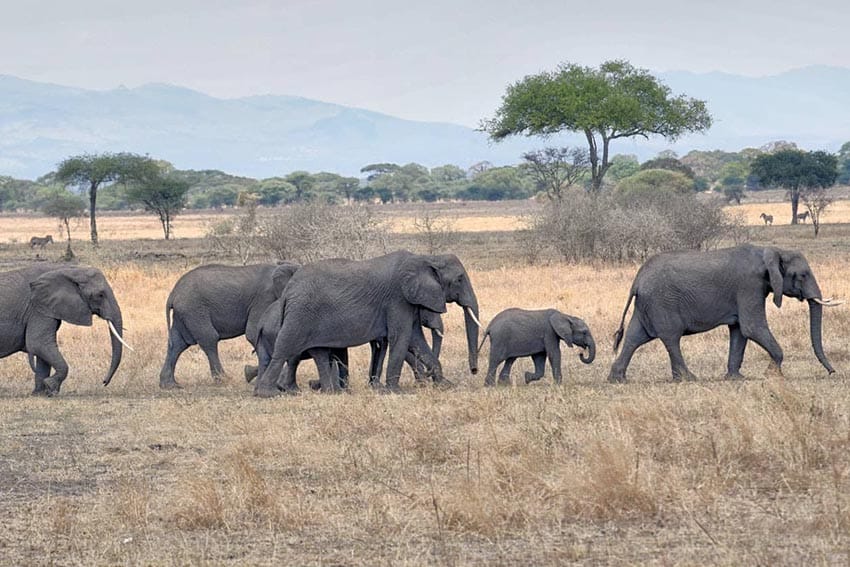
Sleeping with Elephants: 50 Years of Insanely Great Exploration: An excerpt from The Art of Living Dangerously
By Richard Bangs
Richard Bangs is out with a new book about his life of travel and guiding around the world. The Art of Living Dangerously is his 20th book. Here is an excerpt about sleeping with large animals all around you.
It was the last night of exploring remote Zambia, and we saved the wildest place for last, Mandevu Park, a 50,000-acre private game reserve on the lower Luangwa River that had yet to appear on any map.
 We had supped on a Mexican meal, probably the only tacos and hot sauce in a 500-mile radius, and were sipping G&Ts around a mopane wood fire (a hot-blazing hardwood that “burns as long as your passion”) as the gibbous moon began its bright sweep across the southern sky.
Much of the conversation was about dealing with unexpected African wildlife.
Unlike Kenya, Tanzania, South Africa, and other famous wildlife viewing destinations, Zambia allows “walking safaris” (the concept was invented here by the late elephant control officer, Norman Carr), in which visitors can pad with the animals (the other countries allow viewing only behind a layer of motorized metal).
Earlier in the day, we had taken a hike, probably the first Westerners to do so, up to the top of Mount Shongon, which means “the place no one goes” in Nyanja, the local language. Along the way we stepped along the footpaths of an array of herbivores and predators.
So, the fireside talk concerned what to do when surprising a beast while wading through high grass or the tangle of thorn trees. Professor Justin Seymour-Smith was the panjandrum on wildlife behavior, and he counseled across the flames:
“You never know what a wild animal will do. Meeting you without warning on its turf it might turn and go away, or it might charge.
There are no shortages of tales in Africa of folks who have been on the wrong side of animal whim. But there are some general rules.
If you encounter a big cat, never run. Stare it down and slowly back up, otherwise it will chase you like a house cat to a mouse; if you chance upon a gorilla, crouch down and bow your head as though praying; if you bump into a hippo or croc or poisonous snake, run like a rat—but you don’t have to run faster than the animal, just faster than your friends.”
Exhausted from our aggressive wanderings that had taken us from the secluded Busanga Plains in the west to this hidden preserve on the Mozambique border, I announced an early retirement, before the professor finished his dissertation, and toddled to my little North Face Lunarship tent pitched on the high mud banks of the Luangwa River.
The others were staying in “chalets,” grass huts with beds, showers, and flush toilets, but because I am a world-class snorer, I courteously offered to pitch a tent one hundred yards from the rest. Besides, I liked looking up through the mosquito netting to the Southern Cross.
 For some reason, sleep was not forthcoming, and I rolled about in my bag for some time. I felt the cold air from the canyon downstream creep in. I heard the sighing of the river, the whir and chirp of crickets, and later, the voice of an owl, like a dark brushstroke on the night.
Then about 10 p.m., I heard some rustlings upriver. I sat up. The moon showered the desolate glow of a dream onto the scene; the light on the winding river was luminous as a pale shell; and the lineaments of the upstream trees seemed to be swaying. Hippos, I thought.
The night previous I had been awakened when a couple of river horses were snorting in the shallows not far from the tent. Hippos graze at night, entering and leaving the river along well-trampled paths, and my little tent was pitched a prudent distance from any such corridor. So, I rolled over and again attempted to force sleep. But the crackling continued, and was getting closer, or so I imagined.
But after a few turns of the hourglass, the sound abated. Something, though, seemed not right. I sat up again and peered through the mosquito netting. The ridges of the hills were crowned with a moonstone radiance, melting into a profound blue in the shadowy ravines.
Everything—the kith of hills, woods, ancient rocks—hung in chasms of blue air; the whole valley was floating veiled in quivering liquid light. Cloud shadows drifted imperceptibly across the sea of trees, deepening the blue to indigo. It seemed I was looking at the ghost of a world, a lost world.
I squinted and scanned the horizon. At first, I detected just a gray blur against the dark foliage upstream. It might have been a tree. Or a cluster of bushes. But it moved. It disappeared and reappeared again further down the bank. At last, it lumbered out of the surrounding tangle of shrub and creeper and emerged at the edge of the riverbank.
It was no longer just a blur but had shape and form . . . an elephant form. Loxodonta africana, a thunderhead of flesh and huge rolling bones with long white tusks flashing in the moonlight. Slowly, almost imperceptibly, it crossed the bank toward my outpost, with pauses now and then to fan out its ears, and perhaps meditate, or dream.
The jumbo tread closer and closer; my heart, already shaking at the cage of my chest, began to throb. Never had I seen a beast so big so close. If life is measured not by the number of breaths taken, but by the moments that take breath away, I was extending my life by a load.
About five feet from the entrance to my tent, he halted and stared inside with a look of wildness no civilization could endure. I remained as motionless as I could and looked back into eyes like clear brown water.

Then a cramp in my leg developed, so I tried to reposition it without making a sound, but I rubbed against the sleeping pad, which made a squeak. The elephant swung his trunk towards me, and I could see the symmetric ridges emptying, like rained geometry.
He sniffed, then stepped back a foot and flapped his ears, the way elephants do when angry or about to charge, or so I thought I recalled from documentaries and picture books. Was he about to charge? I wished I had stayed to hear more of Justin’s animal escape advice.
Should I try to unzip the tent and run? Should I clap my hands like a rifle shot and see if he will run? Should I shine my flashlight in his eyes? Should I lie down and play dead? I had my Iridium sat phone in my fanny pack. I wished I could call David Attenborough. Or Justin. Or Simon, a professional hunter sleeping on the other side of camp.
But I had no numbers to call and was certain the elephant would hear my voice if I did. So, I just froze in a sitting position and watched as the elephant circled my blue cocoon to the other side and began to make long siphonings on the sausage tree that spread above me. Whew. I relaxed a bit.
He was ignoring me. But then I heard what sounded like sawing upstream. I looked and saw a huge acacia swaying in the moonlight, like the treetops in Jurassic Park before a sauropod appeared. Another elephant was rubbing his broad back against the tree on the camp perimeter.
Then it stepped from a palisade of thorns onto the campgrounds following the footsteps of its predecessor, along the rim of the river toward my tent. He was bigger than the last, an animal magnitude from another time, and the glint of his tusks brighter.
With smooth, rhythmic strides he moved to the very edge of my tent, and he too stopped and glared inside. His great fanned ears moved slowly to and fro. His breath poured through the netting and pressed down on my shoulders. As he altered his position in the moonlight, the shadows showed the structure of his great body, immensely heavy, slung from mighty backbones, supported by columnar legs. I could not help but think he looked like a baobab come to life.
The sublime is conceived as a quality of magnitude or natural force that inspires ineffable feelings of awe, wonder and insecurity in the onlooker. The emotional response is an overwhelming sense of the power, grandeur and lusty stealth of nature in its most terrifying of moods.
This was, with little doubt, a sublime moment.
Now one bull was chomping on the tree next to me and another on the other side starring me down, two oversized rolling bags of horror. And my stomach started to growl. The Mexican meal was starting to process, and I couldn’t hold back a sound. It piped from my tent, and both elephants turned to glower and flap their giant ears.
My God, I thought, I am about to be stomped to death by elephants. Genuinely frightened, I felt my heart fly around my insides. My mouth went dry as a winterthorn, and my limbs shuddered. I thought about rolling the tent down the bank into the river, but then remembered I had tethered it to the sausage tree so as not to blow away.
And besides, the river was filled with crocs and hippos. The tether rope then made me quiver. The first elephant was a yard away; if he moved forward and tripped on the tether, he would fall on my tent, crushing the ingredients.
I considered again making a run for it, but then remembered how much noise the zipper makes, and knew it would cause the elephants even more alarm. Then I heard a sound like Niagara by the tree. My bladder was full as well and was beginning to howl. Too many G&Ts. I was terribly tired.
But I dared not close my eyes. The thought of being trampled with eyes open wide was bad enough. But I knew if I fell asleep, I would snore, and I could think of nothing worse than a squashing while snoozing. So, there I sat, stiff as new shoes, as the elephants scoffed and sniffed and chivvied about me. Elephants can eat for 20 hours a day, then rest the rest. A long night this might be.
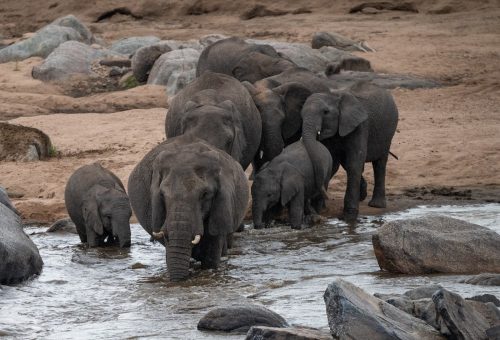
But then after a couple of hours of munching, the two leviathans laid down in a sandy spot below my tent and went quiet. I took advantage of the respite and also laid down but commanded myself to not fall asleep.
But my eyelids were heavy, and my mind wandered about in a haze of unbeing. I heard some crunching, sat up, and looked through the mesh. Did I nod off?
The moon had crossed the sky and sunk behind the trees. In the now quite dark landscape, I could barely make out a silhouette shambling back upstream.
With an unhurried pace it moved back into the shelter of the trees, entwined itself within branches and leaves, and then it was gone.
There was no other sound, save the litany bird, whose call seemed to cry, “Good Lord, deliver us.” There were no more hulking specters. So, I presumed both were gone, at last. But a silent presence still hung in the air. I was about to burst, so I unzipped the tent and leapt outside to relieve myself over the small bluff above the river. Just as I finished, there was a basso profundo bellow that ripped open the night just a few yards below me.
I had pissed on the other beast, who was sleeping down the bank by the water’s edge. I dove back into the tent, rezipped it, and hurdled into my bag. There was a subtle spark to his tardigrade pace as he clambered up the bank, to the frame of my tent, and fixed a walleyed stare. Our eyes locked, and for a second I thought I saw a display of avere misericordia, a hint of empathy for a small, vulnerable creature wrapped in nylon.
Then the elephant turned and plodded back into the bush. And into a deep and anodyne sleep I fell, returning with the dawn to a more managed, if less noble, wild place.
 Richard Bangs is founding partner of the adventure travel company MT Sobek and the travel storytelling platform, Steller. The Art of Living Dangerously is his 20th book.


- Booking Travel from Different Parts of the Middle East - May 27, 2026
- Birmingham: Visiting England’s Least Cherished City - May 26, 2026
- Cruising the Red Sea - May 25, 2026