
Day Tripping Around the Duomo in Florence
Exploring Florence’s UNESCO World Heritage Site, with or without a guide
By Debra Smith

We stood in the crowd at midnight, outside the Cathedral of Santa Maria del Fiore in Florence, candles flickering in our hands.
Easter mass had just ended, and from somewhere in the darkness came the rhythmic sound of boots crunching down a cobbled street. From out of the gloom, a squadron of soldiers appeared and stood at attention, dressed in Renaissance capes and tights.
The light from our candles glittered on their silver helmets and elaborate breastplates. At a signal from the bishop, they marched out of the square in formation, disappearing like ancient ghosts into the night. We had just witnessed a re-enactment of the departure of Florentine troops to the First Crusade in 1097 from the Cathedral of St. Mary of the Flowers, also known as the Duomo di Firenze, or simply, the Duomo.
Taking it all in – the Duomo of Florence
This massive cathedral has dominated the Piazza del Duomo since the 1300s. Part of a UNESCO Heritage Site that includes Giotto’s Bell

Tower and the Baptistry of St. John, the Duomo in Florence is one of the largest churches in Italy.
It seems to press the surrounding buildings out of the way with its overwhelming volume of 89,340 square feet (8,300 sq. m.). It’s almost impossible to get all of it in one picture, especially when it’s encircled by never-ending lines of tourists.
The Duomo’s Double-Walled Dome
The cathedral’s most famous architectural feature is its double-walled dome. One hundred years after construction began the 144 ft (44 meters) nave was still open to the rain and wind, in the hope that technology would catch up with faith. In 1367 Filippo Brunelleschi made that leap.
He modeled the dome after the Parthenon in Rome, based on an idea he “borrowed” from Neri di Fioravanti. A famous art history scandal suggests that he won the competition to build the dome by making an egg stand upright, and, not to belittle his genius, but it does look a bit like a massive hardboiled egg in a cup.
Behind the Scenes at the Opera Duomo Museum
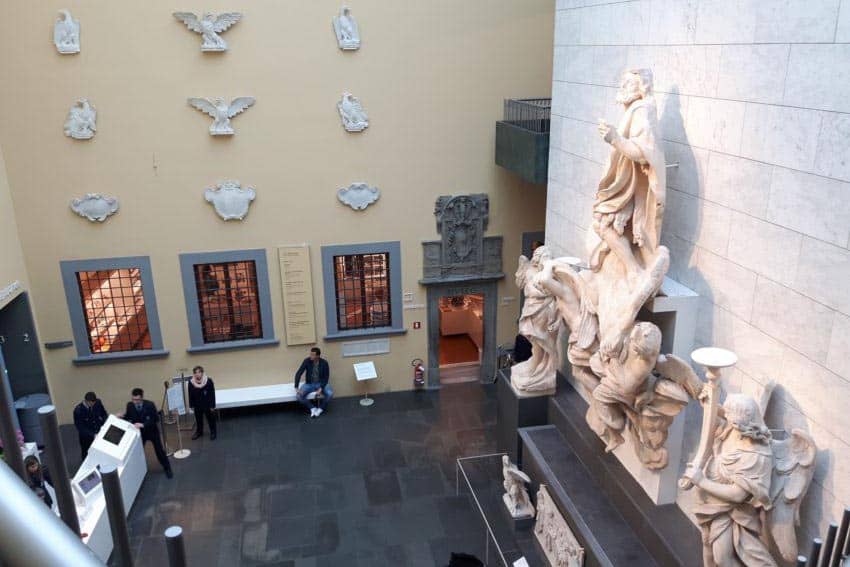
The exterior is a fairly recent addition, by Florentine standards. The green, pink and white banded marble façade was completed in 1887. For a glimpse of how the Duomo looked in centuries past, head into the new state of the art Opera Duomo Museum behind the cathedral. Original statues, ornate carvings, and sculpted choir lofts form part of a full-sized recreation of the Renaissance façade and interior.
There’s much more to see at the museum including the recently restored original gold doors of the Baptistry by Ghiberti, called the Gates of Paradise. Ornate carvings of the planets, the sacraments, the arts of astronomy, farming and more that once graced the heights of the bell tower can be easily seen here, hung at eye level.
Precious intricately carved religious objects are beautifully displayed and there’s also a children’s area with hands-on exhibits.
Ticket for Crypt and Baptistry
You can buy a ticket at the museum for the Baptistry and the Crypt. Brunelleschi is buried there, perhaps still keeping an eye on things in spirit. The tickets are good for 72 hours and also include a timed reservation to climb the Bell Tower and the Dome, 171 foot (52 meters) above the nave.
Be warned that during the busy summer months you may have to wait a few days for a reserved spot.

An excellent alternative, if you’re pressed for time, is to join a Florence tour. You’ll gain access to places that are off-limits to other visitors, like the Northern Terrace of the rooftop, 105 feet (32 meters) high.
This was the spot where Michelangelo had planned to place his famous statue of David. Its lofty perch overlooking the Piazza meant that the statue had to have very long arms and a large head to be viewed in proportion.
The sculptor allowed for this using a technique called foreshortening. Ultimately, the six-ton statue proved too heavy for installation on the roof, so it stands in the nearby Accademia Gallery.
A guided tour may also visit the ancient workshop where Michelangelo carved David, and where restoration work on the cathedral complex continues to this day.

A Renaissance Bible – the Baptistery of San Giovanni

The origin of the Baptistry is lost in time. Some scholars believe that it was part of the original church that was built on this site sometime between the 4th and 5th centuries.
What’s known for certain is that Andrea Pisano cast the bronze doors to the southern entrance in 1336. The 28 panels depict the life of John the Baptist and the Virtues.
The 28 panels of the northern doors were fashioned by Ghiberti as a visual guide to the New Testament and the Church Fathers and took him 21 years to complete.
This paled in comparison to his masterpiece, the 10 gold panels of the east doors, which took his studio 27 years to create.
His scenes from the Old Testament were revealed to an astonished public in 1401 and quickly dubbed The Gates of Paradise.

The final building to conquer in the complex is The Campanile, also called Giotto’s Bell Tower. The panoramic view of the city at the top of the 414 step staircase may be the best in the city.
The red tile roofs, rolling hills, and shining river are laid out like a topographic map at your feet. There are binoculars available outside and some of the seven sacred bells are rung every fifteen minutes. Be there at noon for maximum volume.
Getting Lost in Florence– in a Good Way
There are a wide variety of Florence tours, within the city itself: walking tours, Segway and electric bike tours, tours for foodies, art lovers and opera buffs.
You’ll gain a knowledgeable guide and front of the line access. Take time to simply stroll on your own too.
Ferragamo Shoe Museum!
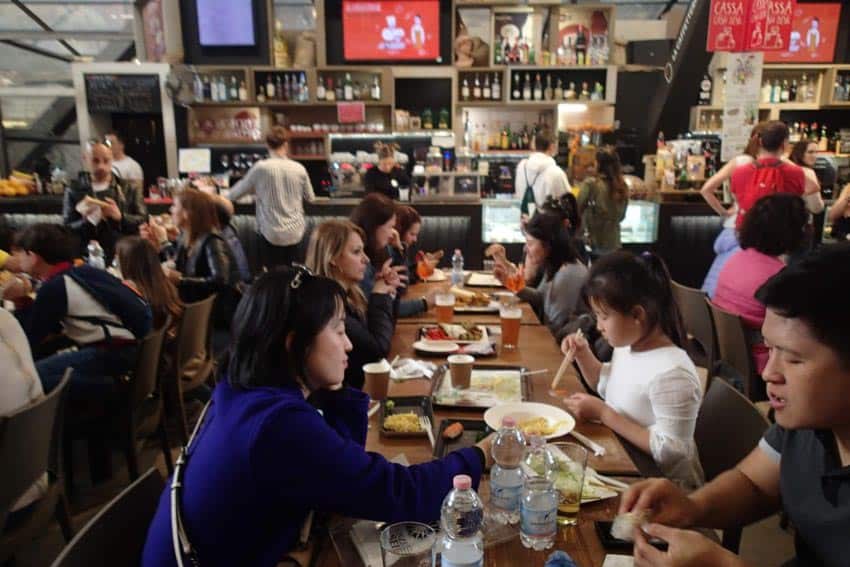
Florence is a wonderfully walkable city and you’ll want to explore, to discover some unexpected pleasures like the Mercato Centrale food court and market, and Move On, the bar and vinyl record store in the Piazza del Duomo, the Ferragamo Museum with over 10,000 pairs of the designer’s shoes, and Florence’s trattorias and gardens.
If you’re there on Easter Sunday morning, you can even watch the soldiers return, part of a colorful, exuberant Easter parade that makes its way each year to the heart of Florence, the Duomo.


- Living Free as a Digital Nomad in Thailand - May 21, 2026
- The Quiet Travel Moments We Remember Most - May 21, 2026
- Portland Maine for Tasty Lobster and City Flair - May 20, 2026

April 27, 2020 @ 1:47 pm
From our friend in Florence: “The restaurants on the first floor and on the ground floor are closed for sure, only food shops are open: I’ve not been there but the entrance will be limited to a maximum number of people together as for all the shops.”
Don’t worry you will be able to return there later this year!
April 27, 2020 @ 11:27 am
is the Mercato Centrale open during the shut down?