Costa Rica: A Rainforest Chocolate Tour

Chocolate in the Rainforest of Costa Rica: Who Can Resist?
By Judy Karnia
Chocolate is my thing. I am choosing chocolate if there is ever a choice between chocolate and not chocolate.
My other passion is nature. So, when I had the chance to do a chocolate tour in Costa Rica–the best day ever.
Sometimes seeing the sausage being made leads to a decrease in your desire to eat that substance. However, learning how cocoa beans are grown and processed led me even deeper into my appreciation of the best food item in the world.
The Rainforest Chocolate Tour in La Fortuna Costa Rica doesn’t produce any chocolate products but it educates visitors as to how chocolate is grown and processed.
Their mission is to make people aware of the exploitative practices that large chocolate companies use and how to choose “fair trade” options. Their work promotes environmental conservation and responsible tourism.
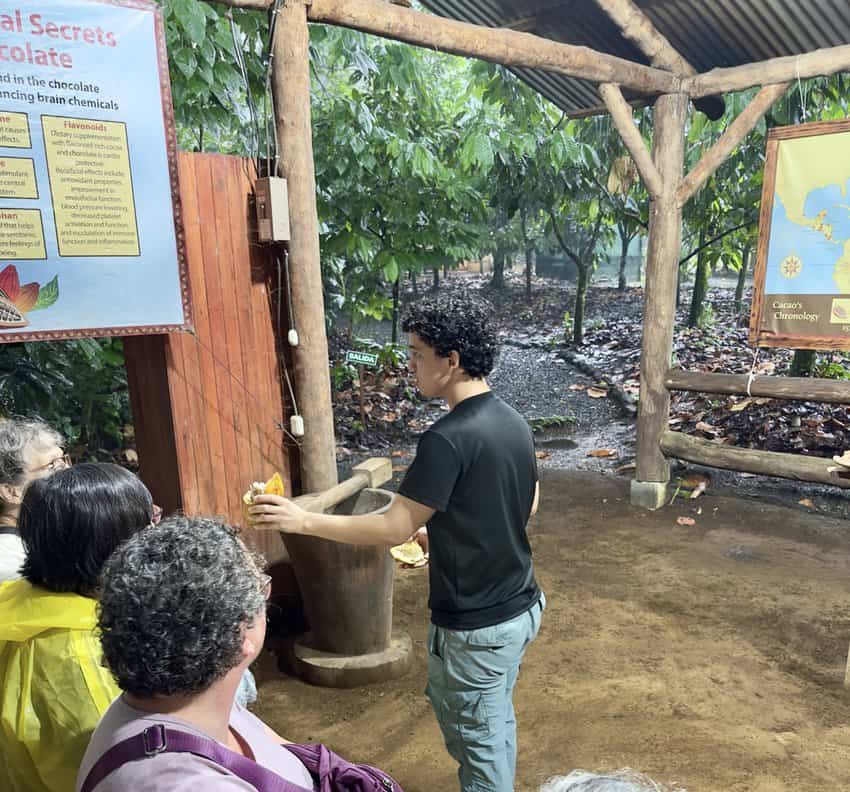
While attending a forest bathing retreat in the mountains of Costa Rice, our group of ten joined a family of four from Philadelphia for a chocolate tour. Elio, our guide, gathered us to begin the adventure and quizzed us on where chocolate originated. Many of us were unaware that it was first harvested in Southern Mexico and Central America.
The first use of chocolate is believed to be by the Olmecs in Central America around 1500 BC. The Mayan people revered it, using chocolate drinks in their ceremonies and combining it with chili peppers for daily use. The Aztecs went beyond consumption to using cacao beans as a currency more valuable than gold.
Spanish Thought it Bitter
The Spanish explorers that were introduced to it likely considered the cacao beans and liquid to have an unappealing, bitter taste. They soon discovered that adding sugar or honey greatly improved it and started bringing the beans back to Europe in the 1500s. The mass production of sugar cane with slave labor led to the vast adoption of chocolate production throughout Europe and the American colonies.
During our time at the Rainforest Chocolate Tour, Elio explained that most large corporations source their cocoa beans in West Africa, using child labor and exploitative practices on their workers. They often pay them in food and housing so they can never move on.
Today, only five companies produce 50% of chocolate products and hoard most of the profit. Fair trade chocolate made in Central and South America, on the other hand, is mainly grown by small farmers and produced ethically. The price may be higher, but the farmers earn a much better living.
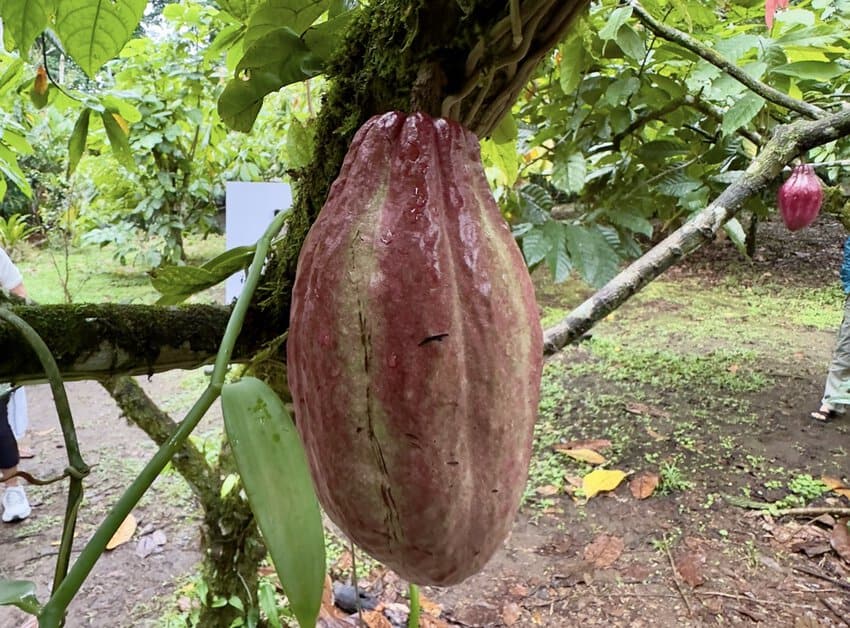
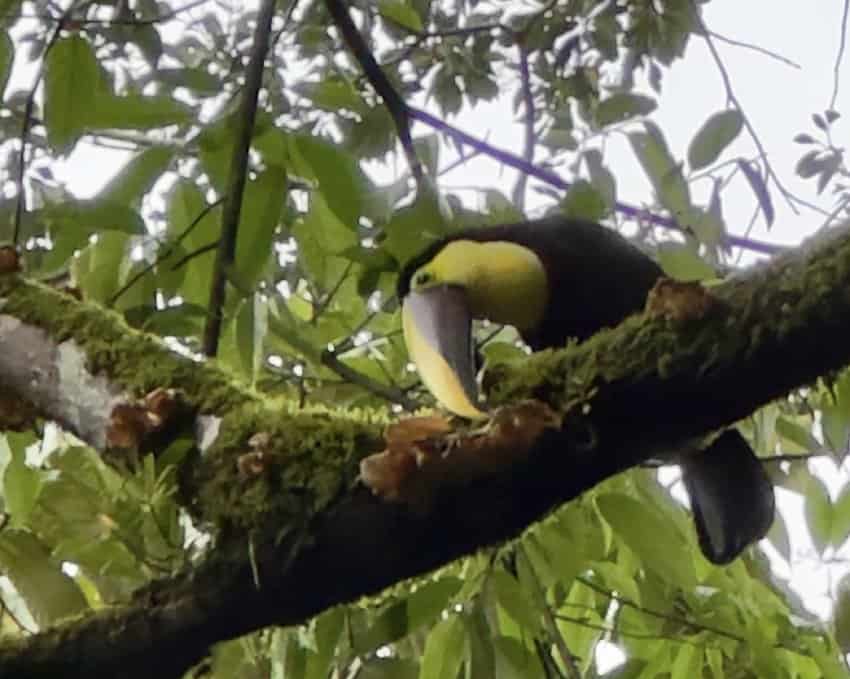
As Elio led us across a bridge to begin the tour, he pointed out a toucan sitting high up in a tree. We first entered a wooden-framed hut where cocoa beans were fermenting. He suggested we open a husk and taste the cacao bean inside but warned us that it would be bitter and not taste good. I thought it tasted wonderful: pure dark chocolate. He then showed us the thin branches from which the oval, brick-red pods hung. Vines with vanilla beans hugged the trees.

As the rain started to fall heavily, Elio jogged us under a two-sided covered building. He asked our retreat leader Jackie to crack open a ripe pod, now a butter yellow color, the traditional way – slamming it against the long bench on which we were perched.
He showed us that the open pod, which was the size of a small spaghetti squash, was filled with creamy slime surrounding the cocoa beans. He scooped out a bean for each of us to suck on. I was surprised that it had a sweet flavor, almost like melon.
Elio then showed us a rack with seven sections, one for each day that the beans had been fermenting. From the seven-day-old batch, he filled a bowl and brought it to a three-foot-tall mortar and pestle. Vilerca, one of our group, had to use both hands and the strength of her body to pound the beans to loosen the husks. Ronaldo, our other guide, poured the beans from one bowl to another as Elio waved a plate to blow away the husks.
Maria then turned the hand crank on a grinder to turn the beans to powder and Ronaldo mixed up a wonderful chocolate drink that he served in tiny wooden cups. Next came my favorite part of any tour I have taken when traveling: Ronaldo made a thick, rich, dark chocolate syrup. Elio handed us each a small metal spoon and we lined up to get our spoon filled and topped with various flavors.
We rotated in a circle to get our spoons refilled and tried different combinations of toppings. I started with peanuts, then cocoa nibs, then nibs with salt, tequila and salt, rum and chocolate nibs, cinnamon, chili powder, nutmeg, and cloves.
Just when I thought I had my last sample, someone mentioned a toppings combination that I couldn’t resist trying. I went around and around until everyone in our group was marveling and laughing at how much chocolate I could ingest.
As our tour ended, we passed a banner that listed the chemical substances within chocolate that affect our brain: mood enhancers such as tryptophan, theobromine, and phenylethamine; the stimulants caffeine and anandamide; and flavonoids which have many health benefits.
These show the many good reasons I should continue to ingest chocolate every day.
Our group then mobbed the shop at Rainforest Chocolate Tour. I chose several dark chocolate bars from various Costa Rican companies, all with beautiful packaging and colorful artwork featuring animals and plants. I faked that some were to be gifts, but let’s not kid ourselves, I am going to eat them all.
La Fortuna, in the mountains of Costa Rica, offers many fun activities based on the local culture and natural beauty. The Rainforest Chocolate Tour is well worth a visit due to its educational focus and support of fair-trade farmers. Chocolate lovers can also find no better place to pay homage to the best food substance that nature has provided us.
Judy grew up on the south side of Chicago and now lives in Scottsdale, Arizona. She studied Latin at Northwestern University and her favorite place to visit is still Rome. Her writing focuses mainly on the cities she explores, experiencing their art, parks, food, and music. After 28 years as a veterinarian, she travels the world and shares her adventures through her writing.


- Gifts for the Stylish, Thoughtful, Home-Loving Dad - June 2, 2026
- Father’s Day Gifts for Traveling and Adventurous Dads - June 1, 2026
- How to use Avios Points to Reduce your Travel Costs - May 29, 2026