
Apalachicola is a Special Part of Northern Florida
By Herb Hiller
Florida marketers climb all over themselves like fiddler crabs frenzied by lunching herons. They’ve branded peninsular Florida as the Conch Republic and Gold Coast, the Internet Coast, the Platinum Coast, Treasure Coast, Research Coast, Space Coast, Fun Coast, Historic Coast, First Coast, Paradise Coast, Suncoast, Nature Coast, and Original Florida.
The Panhandle persisted as the Redneck Riviera long after its first formal branding as the Playground Area of the Gulfcoast. When golf and shore resorts began replacing timberlands in the western Panhandle, marketers up-branded the region between Pensacola and Panama City Beach.
Florida’s Forgotten Coast
The new Emerald Coast literally left the eastern Panhandle off regional maps, whereupon those non-places declared themselves the Forgotten Coast. So they have remained even during the housing boom when real estate interests pronounced the Forgotten Coast déclassé.
One land company marketer instead proposed “Unforgettable,” which critics dismissed as utterly forgettable, and “Uncommon” as emphatically common.
Along the Forgotten Coast, the branding game frames one more battleground between Florida and F*L*O*R*I*D*A.

Towns with Less than 4000 Residents
For 125 miles, no town east of metro Panama City has as many as 4,000 people. Most of the land is public, and most of the way the only east-west road runs alongside big open bays.
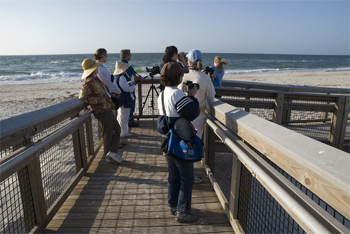
The beaches are Florida’s best, nowhere blocked by either billboards or condos. Spring and fall, north-south SR 65 flames with wildflowers. One island accessible by water shuttle is a breeding ground for red wolves.
People kayak four miles to another mostly owned by The Nature Conservancy with a weatherbeaten inn. Two large state parks preserve the dunes and beaches at the ends of St. George Island and of Cape San Blas.
Still a Bible Belt
Yet the region also remains the Bible Belt from a time when speed traps, illicit stills, and pot smuggling formed the informal economy, peopled by a type that one songwriter characterizes as “Six days a sinner, seventh day a saint.”
Six-day ways show their grip on politics that lately permitted a monstrous transmission line through Apalachicola – the “Heart of the Forgotten Coast” — and the Putin-like arrest of a reformer who challenged a good ole boy for a neighboring county commission seat.
Now land developers are promising jobs to hard-hit economies in return for toll roads through national and state preserves. In the 2012 Republican Primary, Newt Gingrich won all of the Panhandle’s 11 most rural counties.
So maybe the Despairing Coast?

Not yet
Apart from timbering, a kind of tourism has arisen that, different from elsewhere in Florida, combines nature, heritage, the arts and business in a one-of-a-kind place.
Conservation is evolving from passive protection toward an economy of authenticity surrounding this prolific estuary, where three-quarters of the people make their living from the bay.
Their catch generates some $134 million directly and an additional $71 million in value-added impacts, according to Apalachicola Bay Chamber of Commerce Director Anita Grove.
Apalachicola Riverkeeper
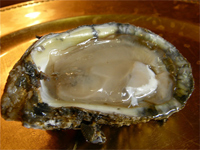
The Apalachicola Riverkeeper, for example, works to keep adequate freshwater flows into Apalachicola Bay that in turn nurtures the estuary. Its oysters, shrimp, and finfish–-none anywhere fresher–show up on menus of waterfront restaurants that range from classy to shacky, in historic buildings that start from Apalachicola’s antebellum cotton past.
Two large interpretive centers convey the estuarine history and the quirky past of St. Vincent Island where an eccentric once sheltered exotic beasts and where today in the national wildlife refuge the red wolves roam.
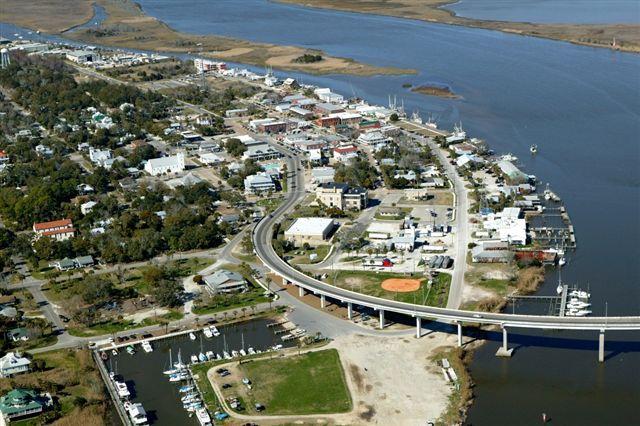
Apalachicola is 100 miles from any Interstate, and accordingly unmarred by exit ramp commerce. It’s the seat of Franklin County that has no mall, no movie theater, no billboard clutter, and only one traffic light – a blinking one.
There’s an old-time soda fountain in a gift shop. Toward sundown, a fiddle or flute may sound from the gazebo in Lafayette Park.
The nearest beach is on St. George Island, a 25-minute drive. West of the state park, stilt houses have gone up willy-nilly. No landscaping, little community, and aspects of stadium parking lot tailgaters. Renters unpack their cars, throw off clothes, and don’t often dress again to visit the town.
Apalach, Florida
That helps keep Apalach Florida’s most beautiful authentic small town — Key West with large lots. Queen Annes in chartreuse green with dormers and turrets sit beside others of mustard shingles and clapboard with wraparound porches; of wedding-cake plenty with ornamental woodwork and a roof of tin tile.
At one that famously stands only half re-done, the owner stopped work when he learned that improvements already made had raised his taxes. Restored houses built by lumber barons now house museums and bed-and-breakfasts. Most were built of black cypress and heart pine, the same used for the “gulf coast cracker houses” today lived in by oystermen and day workers in the restaurants, B&Bs and shops.
Cars arrive from Tallahassee along two-lane Highway 98 carrying kayaks and bikes. Between pine forest and sparkling bay, creeks trickle through the salt marsh. Cypress limbs strew narrow bay beaches with driftwood. The road hugs the shore like the costume of an acrobat.
On a foggy evening, the long east-west causeway climbs a bridge over the ship channel where the ramp curves 90 degrees north before it drops to the town bottom.
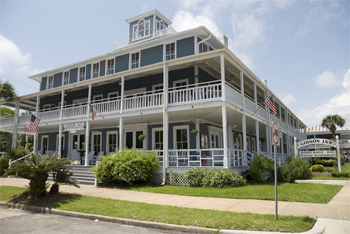
The first faint shape is the 105-year-old steamboat Gothic Gibson Inn. You ease past as if guided by channel buoy moan. Night blankets a street edge where cotton bales once awaited the return of sea captains, who between June and November avoided the yellow fever of Cotton Town. Restaurant lights halo the drippy dark.
Essential Apalach centers along Water Street’s oyster and scallop processing houses and shrimp docks. Wefting’s still purveys utilitarian marine hardware and supplies from its 103-year-old store. The town still alphabetizes its east-west streets a class muting “Avenue A” through “M”. But downtown has also turned colorful.
The Old Jail
The old jail is yellow brick. Among galleries and garden supply stores, one place shows fuchsia brick and fuchsia shutters. Another is dull green outlined in purple, another purple-painted brick and board outlined in green. Under its high orange pressed tin ceiling, Tamara’s Cafe Floridita serves its seafood with helpings of reggae and Santana.
Restaurants feature local art. Among those most popular are Caroline’s, Up the Creek Raw Bar, and the Owl Café. Where once the town’s chief attraction was the John Gorrie State Museum that hails the inventor of the ice-making machine (and indirectly of air-conditioning), today it’s also the town’s improvising look.
Artists show up and many soon turn to save the old houses. Interior designer Lynn Wilson turned the Coombs House into an elegant inn. At another, she accommodates her 94-year old mother, Alice Jean Gibbs, a Coca Cola model and original Radio City Hall Rockette.
Cooking school proprietor Jane Doerfer fixed a place for herself (later also acquiring the Pelican Inn on four-mile offshore Dog Island). Dixie Partington fixed one place, and with her late father Rex, also re-established live performance at the burned out Dixie Theater they re-built together.
Photographer Richard Bickel fixed one up across from an oysterman who keeps bees. Richard’s black and white portraits rage against injustice while honoring the town’s salty workforce. Everyone knows it’s the oystering way of life that keeps the entire town together.
Heed Richard, and you feel doubly offended by the spineless government that, in thrall to 21st-century land barons, permitted those behemoth power poles through Avenue F, a part of an African-American district called the Hill. One bank has installed an out-of-character digital time and date sign.
An oil company has put in a garish non-conforming pump station. Lapses or augury? Ironically, it’s the new people who get it more than the old. It’s the paradigm of Florida that as awareness grows the game is lost. As if to mitigate their misfortune, Avenue F folks maintain a community garden.
Renewal in Apalachicola
Emblematic of renewal that began late in the last century is former investment banker Michael Koun’s three-story 31-room Gibson Inn. It’s soft blue, white, and friendly, welcoming visitors with cats in the lobby and a lit fireplace winters when a cold wind blows.
Kathy Willis and her late husband Lee renewed the old Grady Store, built at the site of a cotton warehouse after a fire in 1900. It’s now a collection of boutiques with posh vacation suites called The Consulate in the upstairs space once occupied by a French consul. Oystering brought the artists. The artists brought cachet. Cachet brought the boutiques.
Real Estate Values
Typical of Apalachicola’s turnaround is how real estate values before the recession had risen seven or eight times in Michael Koun’s almost 30 years in town. New plank floors, tin ceiling, refaced Y-beams and re-pointed brick that spruced up jeweler Kristin Anderson’s former studio called for rents of $4,000 a month. Says Michael, “You could only do Porsche or Mercedes repairs there.”
Whatever comes next, it’s hard to avoid a reality put best by retired Estuarine Research Reserve Director Woody Miley. “What we have to establish,” he said, “is that the costs of big-league development aren’t worth the benefits of the fisheries we stand to lose. More people are the greatest threat to the bay.”
Florida In-the-Balance Coast?
Reader Comment:
I specifically wanted to ask you about your statement referring to the oil company. I can not be sure what company you are referring to but think it must be the only one located in Apalachicola – J.V. Gander Distributors, Inc. If I am correct, I thought you might be interested to know that this company dates back several generations and was managed and is owned and worked by a local family.
I thought you might be interested in researching the historical details to correct your previously printed statement. Much of the earlier fuel customers were shrimpers, oystermen and fishers who fueled their vessels from the dock. I do not know when the company was founded but do know that Mr. J.V. Gander is now 90 years old and his mother operated the company before him.
Ironically, I am one of the “old” people that you refer to in your article who may not “get it” I was born and raised here, left and returned, and I do get the changes we have undergone and do appreciate what we have retained and have lost. I think the “old” people do not get enough credit in many ways. I love the “new people” and enjoy meeting people everyday who love and share my home.
However, I do get frustrated when statements are made that are unfounded or at least unresearched. Had you approached the company and taken a moment to speak to those who work inside you would have found a family with deep roots and a love for Apalachicola. They would also have been glad to tell you anything you wanted to know about the history and evolution of the company. Maybe then it might not have been so garish to you. You would have also known that it was not “put in” but has been and is just another example of the uniqueness and history that is Apalachicola. Thank you, Donna Duncan
Dear Ms. Duncan. Your family’s long presence in Apalachicola duly noted. However, nothing you say refutes my observation that the gas station I saw shows a garish disregard for the character of the town. I found no need to speak to anyone at the company about something plainly visible. It is, regrettably, part of the “history that is Apalachicola.”


- Armstrong, Florida on the East Coast Greenway - July 17, 2015
- Athens Georgia: A Dot of Blue in a Sea of Red - July 11, 2014
- Cherish Trains Again: Southern Railroad Travel - January 7, 2014

Nick,
I hear your passion. It’s misplaced. You don’t like some of my words? That’s okay.
But when you say “I miss the whole damn point” of Apalach, I’m afraid that you’re projecting your own outlook on me.
You comment that “I prefer to catch Reds in the East River by day and eat oysters and drink beer in Apalach at night. That’s where the real stories of this town come from — The Bay–and you barely glossed over it.”
First, the real stories are how the oystermen have been unable to prevent their economic decline because of freshwater hogging by metro Atlanta that reduces flow down the Flint/Apalachicola River and increases bay salinity. That’s tragic.
Second, it’s the story of good ole boy government that let the historic town die and still leaves county education in shambles — 7 in 10 kids economically disadvantaged; among all, graduating with 50 percent proficiency in reading and math. But who cares so long as they catch a few Reds, get to eat oysters and drink beer, drive to the Piggly Wiggly and head to Panama City Beach for a blast. Run the monster concrete power poles through the residential Hill community? So what.
A quarter of my words raised these issues, way more about issues than in the usual GoNOMAD travel piece.
Let me establish that I became aware of issues concerning Apalach, Eastpoint, St. George Island and Carrabelle from talks with Woody Miley, Dan Tonsmeire (first when he managed the Pelican Inn on Dog Island), and Richard Bickel, who first took me kayaking on the river.
Nick, your “yuppies” not merely “created a beautiful and vibrant culture of art that wouldn’t exist without them.” They saved the whole downtown while restoring its National Heritage District character. I’m out of touch for some years now, but your complaint seems more a lament than you care to consider. Too many beers?
Herbert Lewis Hiller
Ecotourism Planner/Writer/Lecturer
herbhiller12@gmail.com
(386) 547-0395 (c)
321 N. Clara Avenue
DeLand, FL 32720
“We did not come so far only to come so far.”
I’m sorry, but what kind of wild ass mosaic of the english language are you trying to wield here to describe the town that I love so much?
Phrases such as “ease past as if guided by channel buoy moan..” or better yet “restaurants halo the drippy dark..” are your best attempts to paint Apalachicola in prose? No, by far my favorite is.. wait, let me find it again so I don’t misquote it.. “The road hugs the shore like the costume of an acrobat.”
This is the most pretentious piece of travel literature I have ever had to lay eyes on and I feel that travel writing is inherently pretentious from the onset. Wow. For goodness sake give me something that makes me feel like I’m back in Apalach. Not this pop-art poetic ensemble of words that is just a semblance of the real place.
The only thing even slightly pretentious about Apalachicola is the yuppie population that resides there, although I must admit they’ve created a beautiful and vibrant culture of art that wouldn’t exist without them.
With the picture you paint of this town you make me begin to prefer Eastpoint. I prefer authentic. I prefer to catch Reds in the East River by day and eat oysters and drink beer in Apalach at night. That’s where the real stories of this town come from–The Bay–and you barely glossed over it. You cast only the faintest light in the least amount of words possible concerning the subject that makes up the heart and soul of this town. It’s the bay that it dwells on the edge of–and the arteries, the beautiful rivers and their abundance in biodiversity unfound almost anywhere else in the country, that make this place so special. You missed the whole damn point.