
 Volunteering On An Organic Farm in New Zealand
By Celeste Brash
Vegetarian lasagna, whole-grain buttered bread, green salad and fresh peach pie for dessert.
I wonder if WWOOFers eat like this every night, or if the extraordinarily fresh produce and supplies were left especially for our arrival.
After all, I can’t recall hearing that agricultural workers anywhere ate this well, let alone volunteers on an organic farm near Napier, New Zealand.
WWOOF in New Zealand
The meal has been communally prepared by the combined expertise of the three nationalities working as volunteers through Willing Workers on Organic Farms (WWOOF), an organization that brings people from all over the world to work and learn on organic farms in Canada, Australia, New Zealand, Ireland and elsewhere.
Orchestrated primarily by an Australian couple who will be leaving tomorrow for a sheep farm on the South Island, my American husband and I helped in the meal preparation where we could.
| How to Freedom Camp in New Zealand |
Lee, an amiable Korean man who has come to New Zealand to learn English was responsible for the beautiful pie. After kitchen cleanup, we head off to our small, trailer-like bungalows for an early night. There will be lots of work to do tomorrow.
An old flatbed truck picks us up at 6:30 am and we wave good-bye to the Australian couple. Lee embraces them and all three become teary-eyed, promising to keep in touch. In the truck, we are in the company of a leathery Kiwi couple named Ken and Trudie. They tell us a bit about the work we will be doing as they drive us out to a large, flat field of immature lettuces.

“Hope you don’t mind weeding,” laughs Ken.
“And finger blisters,” adds Trudie.
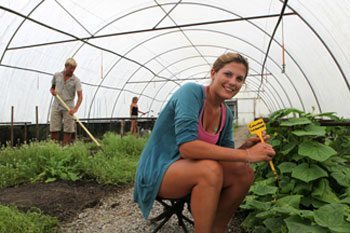
We stop near the field and spend a few moments gazing out over the weed-filled expanse. Lee takes off his shoes, rolls up his pants to his knees and starts on the weeds like lightning.
My husband and I need a few pointers before we can begin, and are given small knives to cut the weeds at ground level. Trudie explains that pulling the weeds out might damage the roots of the lettuces.
On to Picking Tomatoes
By afternoon we are all sunned, dirty and have moved on to picking tomatoes. By evening, we are contentedly exhausted but inspired enough by the array of fresh fruits and vegetables that we cook for another great meal.
Feeling the satisfaction that comes only after a day of long, hard, physical work, I fall quickly to sleep, unable to find any thoughts that might keep me awake.
Three Days a Week of WWOOF Farm Work
For three days a week, we work on the farm weeding, planting or harvesting. The other four days we are free to visit local Napier and Hastings sights, meet with new friends or just relax and read a book. Our kitchen is stocked daily with an impressive supply of farm produce, and we all have our own comfortable bedrooms.
| Finding Gisborne NZ’s North Island Gem |
But, the best part is meeting the local farmworkers who invite us to their houses, show us around the area and even take us to parties.
By the end of a spiritually and physically rewarding three weeks, I find that the only money I’ve spent is on a few beers with friends down at the local pub. But Lee has optimized the experience more than any of us. His determination, aided by a penchant for singing Neil Young songs while weeding, has substantially improved his English skills.
Bringing Outsiders In
But that is what the whole WWOOFing experience is supposed to be about. Created in the UK in 1971 and established in New Zealand in 1974, WWOOF was meant to bring the experiences of different peoples to small, rural farmers, while simultaneously opening up life on organic farms to outsiders.
Once you’ve become a WWOOF New Zealand member, you’ll receive a small booklet listing all of the organic farms that belong to the organization. Call or write the farms that interest you to come up with an arrangement that will please both parties. Most farms require five half days of work per week in exchange for food and lodging while others prefer three full days of work. Free time activities vary by region and the remoteness of the farm.
More than 500 Places in NZ to WWOOF
But what is most intriguing about WWOOFing in New Zealand is the vast amount of variety between farms. With over 500 locations, there is a niche for just about anyone. There are small farms that ask to host families with children, others mention they enjoy meeting musicians or people of particular religious denominations. Sacred Earth Retreat is seeking workers and a on-site managing couple.
Many farms are entirely self-sufficient and interested in teaching sustainable development to others. There are sheep farms, medicinal herb farms, cattle ranches, deer farms, and classic produce farms; there is even one listing for a Buddhist monastery.
With all the choices available and the flexibility of the system, a prospective WWOOFer is sure to find a situation that will make for down-to-earth Kiwi experience and some great meals.
For more information visit WWOOF New Zealand
www.wwoof.co.nz
To get an application that you can send by FAX, post or fill out on-line.
For individuals, becoming a member of WWOOF New Zealand costs NZ$40 from within New Zealand or US$40 US from outside New Zealand. For couples, it’s NZ$40 NZ from within the country or US$25 from outside. WWOOF accepts most major foreign currencies by cash, check or credit card.


- These 9 U.S. National Parks Require Reservations in 2024 - April 17, 2024
- Take a Hike in Olympic National Park - April 17, 2024
- The Wild Mississippi: 2340 Miles Across Ten States - April 8, 2024