

Sardinia: Notes From a Big Wild Island
By Max Hartshorne
GoNOMAD Editor
The Little Piggies Roasted at the Monastery
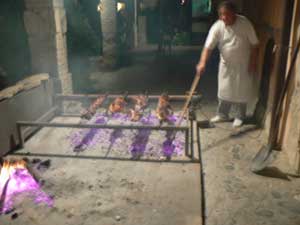
We finally reached Sardinia at about 7 pm, after more than 24 hours of travel and waiting. We had a few hiccups when we got to the hotel; I immediately plugged in my power strip and the room went dark.
We got up and moved to another room and boom, it happened again. Maybe I should not use that surge protector after all.
But we managed to put on our nice clothes and were taken to a former monastery where an elegant banquet awaited us. A man was cooking little pigs on a rotisserie and there were abundant paper cones filled with calamari and fried vegetables.
The high-ceilinged monastery had our voices echoing off the thick walls, and all around the tables there was excitement to see this large and wild island, which for even seasoned Italy lovers is new terrain.
Trying out the 50-foot Diet in Orroli
Imagine eating an entire dinner that came from within 50 feet of your house. In the US, we pat ourselves on the back for the 100-mile diet, and it’s hard to do even that.
But tonight we met a family that runs a museum, a farm, and a restaurant in central Sardinia where everything they serve comes from their own land and their own hands.
Agostina Vargiu and his 79-year-old mom plus various staff and other family welcomed us with a glass of fruity white wine served from ceramic pitchers as we walked up the cobblestone driveway in the town of Orroli, near the middle of this large island.
It’s called OmuAxiu, and it is a memorable place to spend the night or just a few hours over a long dinner.
We had toured the ancient ruins of the Nuraghi, bronze age towers built by the Phoenicians and decapitated by the Romans, who feared that the strategic turrets would serve someone else’s defense needs. These are located on windswept plains with miles of views of distant mountains.
This dramatic site was carefully constructed without mortar, and we shared it with a hoard of about 100 teenagers, who were interested in talking to us about their favorite musicians (Genesis).
The town of Orroli has just 2700 residents and boasts an amazing 35 citizens over the age of 100. So when we met the matriarch of the Vargiu family, who was celebrating her 79th birthday, we knew she was just getting warmed up.

After touring their museum with ancient farm implements, including a Bubba brand tractor from 1918, we parked ourselves in their cellar for the meal.
Like many great foods, it was the simplicity that made it so delicious — roasted eggplant and fennel, redolent of sweet apple, crusty bread and a thinner bread spread with bruschetta, and thin homemade pasta and prosciutto and salamis with their own red wine.
We stopped by a tiny market and bought a uniquely Sardinian pasta called Fregula, little balls that look like giant couscous but cook up like pasta. These were also in the farm’s pasta course.
Then came the carne, veal chunks and pieces of roasted wild boar. We toasted our host and hostesses when they came out to say hello, and sang happy birthday to the smiling matriarch in Italian.
There is nothing that I enjoy more than fascinating conversation over delicious food, and the company of those with knowledge to share and curiosity about the world they travel in. A fine night indeed!
Nora Treats Us to a Glimpses of The Past

We packed a lot into yesterday, but the highlight was Nora. She is an old gal who lives by the sea, a Phoenician-Roman ruins site that was once a well-defended coastal town.
These ruins show the levels of ancient civilizations, layer over layer, and as you walk by the former forum or the home of the patrician, you can imagine life inside these tiny rooms that are just shells now.
The pounding sea made a calming background noise as we toured the former town at the tip of land just east of the city of Cagliari.
After cocktails and dinner with excellent Sardinian wines, we were regaled by a band that included a giant mandolin and a curious reed instrument with three reeds played at once.
The backdrop was a ten-foot screen showing scenes in nature of the wild interior of Sardinia. It was quite a sight, combined with these five musicians, to see the beauty and rough-hewn cliffs that border this large island.
Today we get more of a peek into Sardinian ways of life and meet some of the people who make the wine and create the menus we have been enjoying during our stay.
Meeting the Patriarch at Argiolas Winery
Antonio Argiolas is the patriarch of one of Sardinia’s largest winemakers, of the same name. We met this 101-year-old sprite during our visit to the winery. Since 1937 he’s led the company and now is the retired chairman.
He said he drinks a glass of his wine every day, and that plus Sardinia’s good air is what he credits for his long life. His granddaughter Valentina runs the day-to-day operations, where they have a cooking school and a large winery.
Before we left for our trip, we met a woman who told us about a wine she had discovered at a local restaurant. It was Costamolino, and in fact, it was a product of this winery.
Antonio was clearly pleased to meet all of the nice women in our group and was very proud as he posed for hundreds of photos with his granddaughter. Even though he could not see the visiting journalists clearly, as they kissed his cheeks you could tell he was enjoying the deserving adoration from the Americani.
Varoom, Varoom at Forte Village on Sardinia
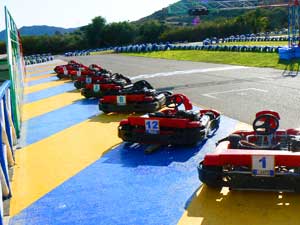
Where can you ride a speedy go-kart around a track built to resemble a real F1 track? And skate on a real ice skating rink, play soccer under the lights, dine in 32 restaurants, or stay either on the oceanfront or in a more intimate hotel setting?
Hint, you won’t have to drive anywhere, because it’s all in the self-contained Forte Village, an all-inclusive resort on Sardinia’s coast.
We got the tour and saw rooms that start at 700 euros per person per night, (that includes all meals and many of the best amenities) right up to 6,500 euros for the beachfront suites which look out over the beautiful Mediterranean.
This place might not be for everyone, but for the person who wants to avoid any driving, have a place for the kids to have fun, and enjoys lots of sports activities and a variety of restaurants and different lodging options, it might be great. Oh, and another great and unusual thing for Italy — they have free Wi-Fi throughout the property.

- Mongolia, the Land of Eternal Blue Sky - April 20, 2024
- These 9 U.S. National Parks Require Reservations in 2024 - April 17, 2024
- Take a Hike in Olympic National Park - April 17, 2024
The nuraghi were built by the Nuragic people some thousand years before the Phoenicians arrived. How can you write a blog and not know the history of the place you’re writing about? Those are two completely separate civilizations. The Phoenicians never made that far inland anyway. You seem to be quite taken with Nora and Tharros which, as much as they are important and beautiful historical sites, do not represent Sardinian civilization but rather its decline. Why didn’t you name the site of the nuraghe you visited?